
1-Minute Safety Checklist
Core PrinciplesIf you only have a moment before your next conversation or date, keep these essential precautions in mind:
The Foundation of Safe Dating
Dating online offers an accessible way to discover new people and build meaningful connections. However, because you are initially getting to know someone through a screen, it is essential to approach new interactions with both openness and practical caution.
Taking care of your safety does not mean expecting the worst from everyone you meet. Rather, it means giving relationships the time and space they need to demonstrate consistency, transparency, and mutual respect. Boundaries protect your personal well-being while allowing authentic connections to develop naturally.
This Safety Centre serves as an introductory orientation to help you navigate online dating confidently. Throughout this guide, you will also find references to specialized articles that explore individual safety topics in greater depth.
Evaluating Profiles & Early Interactions
Thoughtful profile evaluation is an effective first step in filtering out problematic accounts before significant conversation takes place. While no single detail provides complete certainty, certain patterns warrant closer attention.
Common Profile Warning Signs
- Photos that appear entirely staged or artificial: A collection of pictures that resemble commercial stock photography or professional modeling shoots without any natural, everyday moments can be a sign of copied media.
- Inconsistent or contradictory details: Biographical information that conflicts with the user's stated age, location, or communication style.
- Profiles avoiding clear face photos: An account featuring exclusively distant silhouettes, heavily obscured angles, sunglasses in every picture, or inanimate luxury goods.
- Premature emotional intensity: Profiles or introductory greetings that profess overwhelming love, destiny, or intense attachment before you have even exchanged basic conversation.
For detailed techniques on identifying stolen images, examining digital consistency, and spotting manipulated accounts, refer to our companion guides on How to Spot a Fake Dating Profile and Catfishing: What It Is and How to Avoid It.
Safe Messaging & Digital Boundaries
The initial messaging stage is where expectations and boundaries are established. Taking your time during this phase provides valuable insight into a person's temperament, patience, and respect for your comfort levels.
Pressure to Move Off-Platform
One common pattern in online dating is an early demand to move conversation to third-party messaging apps, text messages, or direct phone calls:
- Moving to direct personal messaging reveals your private phone number, which can often be used to discover additional personal information through online searches.
- Third-party platforms lack the built-in safety controls, moderation oversight, and reporting features available within dedicated dating applications.
- Individuals with deceptive motives frequently attempt to isolate conversations where their behavior cannot be reviewed by platform safety teams.
A considerate match will respect your preference to chat within the application until mutual trust has formed. If someone reacts with irritation, guilt-tripping, or persistence when you decline to share your number, treat that reaction as a significant behavioral warning sign.
Suspicious Links and Invitations
Exercise caution if someone sends external links, especially shortened URLs, requests to register on third-party verification websites, or invitations to participate in online contests. These links may lead to phishing portals designed to compromise login credentials or financial accounts.
Financial Requests & Fraud Awareness
Financial exploitation is among the most damaging risks associated with online dating. Deceptive actors frequently use emotional manipulation to create a false sense of obligation, urgency, or mutual partnership before soliciting funds.
Core Principles Concerning Money
- Never send money to an online acquaintance: Regardless of how convincing, urgent, or tragic a personal story may seem, requests for money, emergency assistance, travel funds, or gift cards should be treated with immediate skepticism.
- Be wary of unsolicited investment advice: A common modern scheme involves matches who casually boast about substantial earnings through cryptocurrency, foreign exchange trading, or proprietary platforms, offering to "coach" you into making initial deposits.
- Guard your banking information: Never share your bank account details, credit card numbers, tax documents, or payment app credentials with anyone you meet online.
Because financial deception takes many forms, we cover these strategies in dedicated resources: see our focused guides on How to Recognise a Romance Scam and What to Do If Someone Asks You for Money.
Protecting Personal Information & Media
Maintaining sensible informational privacy prevents unwanted tracking, harassment, or accidental disclosure of your daily whereabouts (for comprehensive operational advice, see our dedicated guide on Protecting Your Personal Information While Dating Online).
Safe to Share Early On
- Your first name or preferred nickname
- General metropolitan area or region
- Broad professional industry or general interests
- Favorite books, films, music, foods, and hobbies
- Mutual values, relationship goals, and lifestyle preferences
Keep Private Until Trust Is Established
- Exact residential street or building address
- Specific workplace, employer name, or daily shift schedule
- Recurring commute times, gym locations, or child's school
- Photos that clearly capture house numbers or vehicle license plates
- Financial status, personal banking providers, or income specifics
Intimate Photographs and Blackmail Risks
Exchanging sexually explicit photographs or videos with someone you have only met online carries substantial risk. Malicious individuals sometimes pose as interested romantic partners to solicit compromising imagery, only to subsequently threaten to publish the material to family members, employers, or social circles unless money is paid (sextortion).
If you encounter pressure or threats involving media, remember that paying extortion demands rarely resolves the situation and typically leads to escalated demands. Cease communication immediately, preserve unedited screenshots of all messages and payment requests, and contact specialist support organizations or law enforcement (read our full guide on Why You Should Never Send Intimate Photographs).
Transitioning to In-Person Dates
Moving from digital interaction to an in-person meeting is an exciting milestone. Following a structured first-date protocol helps ensure you remain safe, comfortable, and in full control of your schedule throughout the encounter (see our complete guides on How to Have a Safe First Date and From Online Conversation to a Real Relationship).
Pre-Date Verification: Video Calls
Before meeting offline, consider arranging a brief video call. While a video call cannot verify someone's complete background, it can provide helpful reassurance that the person matches their photographs and conversational manner. Individuals operating fabricated or misleading profiles frequently refuse or manufacture continuous excuses to avoid appearing on camera.
First-Date Precautions
- Meet in a populated, well-lit public space: Choose an active cafe, restaurant, museum, or casual public venue. Avoid private residences, hotel rooms, or isolated outdoor spaces for initial encounters.
- Control your own transportation: Arrive and depart independently using your own vehicle, public transport, or a ride-share service. Do not agree to have your date pick you up from or return you to your home address on a first meeting.
- Establish a check-in plan with a friend: Share your date's name, the venue address, and your expected return time with someone you trust. Arrange a designated check-in text or call during the date.
- Keep your belongings and refreshments in sight: Never leave drinks, food, or personal bags unattended. If you step away from your table, order a fresh beverage upon returning if you have any uncertainty.
- Stay mindful of alcohol intake: Moderate your consumption so that your situational awareness and decision-making remain clear.
Many venues participate in safety initiatives such as the "Ask for Angela" scheme in the UK. If you ever feel uncomfortable, threatened, or unable to leave a situation safely, approach venue staff or the bar and ask for "Angela." Staff are trained to assist discreetly by calling a taxi or escorting you to safety.
Safety Features on Amoura
In addition to practicing personal caution, members on Amoura have access to concrete account controls, moderation oversight, and privacy tools built into the application interface.
1. Direct Blocking and User Reporting
When browsing profiles or participating in active conversations, safety controls allow you to disengage from uncomfortable interactions or notify our team of potential policy violations. For step-by-step instructions, see How to Report a User on Amoura and How to Block and Report Someone on a Dating App.
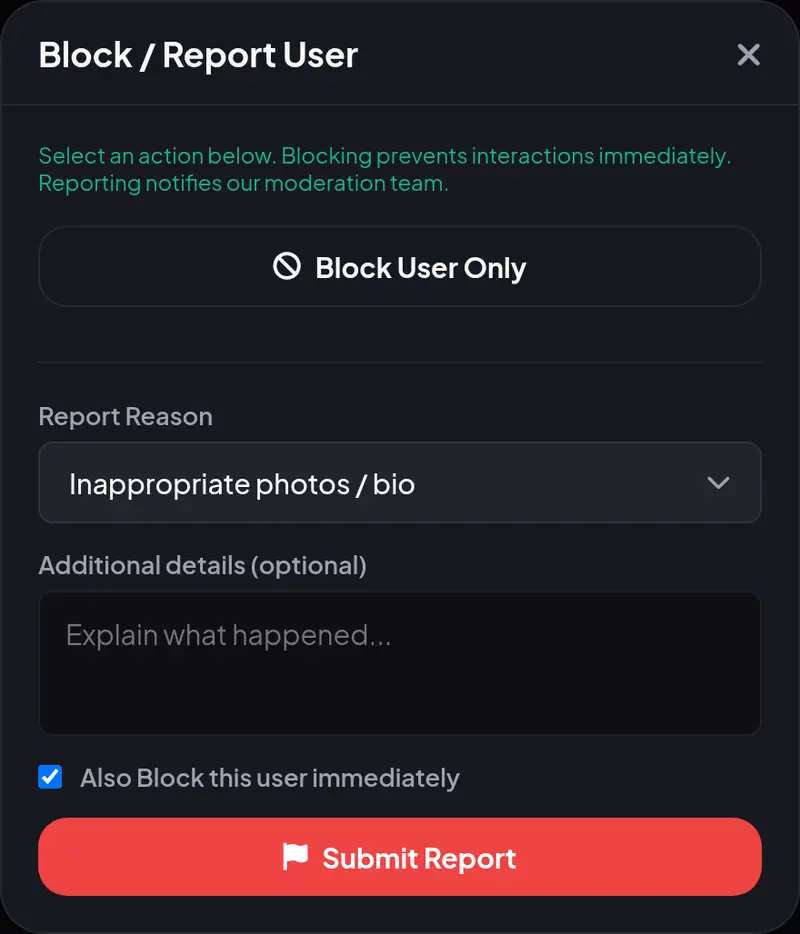
These tools provide immediate separation and help maintain community standards:
- Instant Account Blocking: Blocking a user terminates any active match, closes communication channels, and ensures the blocked profile no longer appears in your discovery deck. The other party is not notified that they have been blocked.
- Categorized Reporting: Reports can be submitted under defined categories, including inappropriate content, commercial spam, fake profiles, harassment, or suspected underage accounts.
- Priority Triage: Reports involving severe concerns, such as harassment or underage safety, are prioritized within the moderation system to ensure swift investigation.
- Simultaneous Actions: The interface allows you to submit a report and apply an immediate block at the same time.
2. Visibility and Account Privacy Controls
Within your account settings, Amoura offers controls to manage how and when your profile is presented to other users:
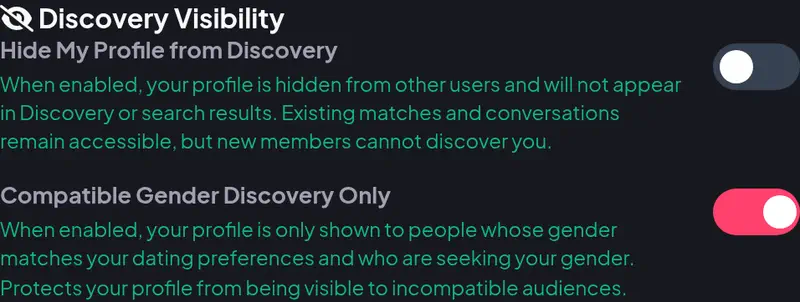
Pause Discovery
Allows you to hide your profile from new discovery decks while keeping existing matches and conversations accessible.
Compatible Gender Matching
Restricts profile visibility so that only members whose gender and preferences match your settings can view your card.
Security PIN Protection
Provides an optional four-digit PIN to re-authenticate and protect unattended sessions on shared devices.
3. Automated and Human Moderation Safeguards
Amoura employs a combination of automated screening and human review to maintain a respectful environment:
- Automated Pre-Screening: Media and profile text are analyzed using automated detection tools designed to catch explicit content, solicitations, harassment patterns, and suspicious link structures.
- Human Review and Escalation: Automated flags and user reports are routed to human safety moderators who evaluate context and take proportionate enforcement action, including issuing warnings, removing media, or terminating offending accounts.
- Responsible Data Management: Content that is formally rejected for policy violations is permanently removed from platform storage.
External Support & Emergency Contacts
Dating platforms cannot replace emergency services or specialized professional support organizations. If an encounter transitions into threats, stalking, physical harm, or severe financial fraud, seek appropriate external assistance:
If you are in immediate physical danger, feel actively threatened, or require medical care, contact emergency services without hesitation: 999 (United Kingdom) • 911 (United States & Canada) • 112 (European Union).
Recognized Support Helplines and Reporting Bodies
- Action Fraud (UK): The UK's national fraud and cybercrime reporting centre. If you have been targeted by romance fraud, file a report at actionfraud.police.uk or call
0300 123 2040. - CEOP / National Crime Agency: The Child Exploitation and Online Protection command handles concerns regarding underage exploitation and minor safety. Reports can be submitted via ceop.police.uk.
- Victim Support: An independent charity providing free, confidential emotional and practical assistance for individuals affected by crime. Visit victimsupport.org.uk or call
08 08 16 89 111. - National Stalking Helpline (Paladin / Suzy Lamplugh Trust): Offers guidance and advocacy for anyone experiencing stalking or persistent unwanted pursuit (suzylamplugh.org or call
0808 802 0300).