
A Request for Money Deserves an Immediate Pause
When someone you met online asks you for money, financial assistance, or help moving funds, your very first action should always be to stop.
This recommendation is not made from cynicism or a belief that people never experience genuine hardship. Genuine people can face genuine financial difficulties. However, digital communication provides unique opportunities for calculated manipulation: stories can be carefully constructed, identities can be obscured, and emotional attachment can be leveraged to create an artificial sense of obligation.
Financial requests in online dating are rarely accompanied by calm, measured discussion. Instead, they are almost universally wrapped in intense emotional urgency: an imminent medical crisis, a stranded flight, frozen bank accounts in a foreign country, or an unmissable investment deadline. This urgency is deliberate—it is engineered to bypass your rational evaluation and push you into reacting out of empathy or panic before you have time to consult trusted people.
Giving yourself permission to pause is not an act of hostility or distrust; it is a fundamental safeguard for your personal well-being. Anyone who truly respects and cares for you will understand your need to keep healthy boundaries around your finances.
Distinct Editorial Scope
This guide focuses squarely on practical response protocols: what steps to take when asked for funds, how to handle pass-through requests, and what to do if money or financial credentials have already left your hands. For detailed explorations of the psychological tactics used to build emotional leverage beforehand, read our companion analysis on How Romance Scammers Build Trust.
Common Types of Financial Requests in Online Dating
Financial requests do not always arrive as a direct, simple ask for cash. They can take multiple forms, ranging from modest everyday requests to complex cross-border financial transactions:
1. Emergency Expenses & Travel
Claims of sudden hospital bills for themselves or a sick relative, customs clearance fees to travel to see you, or stranded transport costs in an unfamiliar city.
2. Digital Gift Cards & Vouchers
Requests for Apple, Google Play, Steam, or Amazon gift cards under the guise of paying phone bills, buying app credits, or covering immediate grocery costs.
3. Crypto & Investment "Opportunities"
Encouragement to deposit funds on a specific cryptocurrency exchange, trading app, or investment website to build a "wealthy future together."
4. Money Movement & Banking Requests
Asking you to receive a transfer into your personal account and forward it via another method, or asking for your banking credentials to deposit funds for you.
A request for financial assistance does not automatically prove malicious intent on its own. However, when the request involves someone you have never spent meaningful time with in person, the objective financial and legal risk is extraordinarily high.
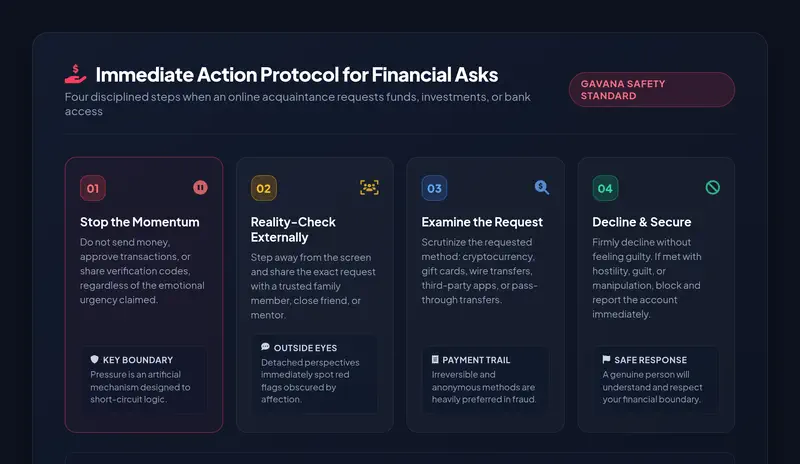
Figure 1: The immediate response framework for financial requests. Prioritise stepping back and consulting trusted external voices before making decisions.
Why the Story Matters: Contexts That Amplify Risk
While the surface reason given for needing money may vary, deceptive requests almost always share specific environmental features. These contextual indicators should significantly elevate your caution:
- Manufactured Urgency: Demanding that funds be transferred within hours to prevent an arrest, medical discharge, eviction, or missed flight. Real emergencies exist in life, but urgency is also the primary tactic used to prevent careful thought.
- Plea for Absolute Secrecy: Asking you not to tell your friends, family, or bank teller about the transaction ("They won't understand our situation and will try to stop you").
- Promises of Immediate Repayment: Insisting that a large wire transfer, inheritance, or client payment is about to clear, and that they will pay you back double the amount within days.
- Irreversible Payment Rails: Explicitly requesting payment methods that cannot be recalled or disputed once sent, such as cryptocurrency, peer-to-peer wire transfers (Western Union, MoneyGram), direct bank transfers, or gift card PINs.
- Emotional Guilt Trips: Reacting to your hesitation with hurt, disappointment, or accusations ("If you loved me, you wouldn't hesitate," or "I thought I could count on you").
If you recognise these converging dynamics, consult our detailed guides on How to Recognise a Romance Scam and Online Dating Red Flags You Shouldn't Ignore for broader behavioral patterns.
What to Do Before Sending Anything
If you find yourself in a conversation where money has been brought up, use this practical checklist to maintain clarity and control:
Do Not Commit Under Emotional Pressure
Acknowledge what they said calmly, but state clearly that you do not send money to people you have met online: "I'm sorry to hear you're having a difficult time, but I have a personal rule never to send money or handle financial matters in online dating." Do not apologize for this boundary.
Talk to Someone You Know and Trust in Real Life
Step away from your messaging app and explain the situation to a close family member, trusted friend, or colleague. Present the facts plainly without defending the other person. Hearing an unbiased outside perspective is often the fastest way to dispel the emotional fog.
Never Disclose Passwords, PINs, or One-Time Passcodes
No legitimate acquaintance, bank representative, or tech support agent will ever ask for your two-factor authentication (2FA) SMS codes, banking password, or card PIN. Sharing these codes gives direct access to drain your accounts.
Resist the Urge to Send Money Out of Social Discomfort
Many people send money not because they are fully convinced, but simply because refusing feels intensely awkward, rude, or confrontational. Remember that an honest person will respect your boundary, while someone seeking to exploit you will escalate the pressure.
If They Ask You to Receive or Transfer Money (Pass-Throughs)
A particularly dangerous variation of financial manipulation involves asking you to receive money on someone else's behalf and then forward it to another account, cryptocurrency wallet, or physical recipient.
The excuse given often sounds plausible: their foreign bank account has high withdrawal fees, their account is temporarily frozen, or a client needs to pay them through a local bank. They may offer to let you keep a "cut" of the funds as a generous gesture.
The Reality of "Money Muling" and Criminal Liability
Allowing your bank account to be used as a conduit for funds from unknown third parties frequently constitutes money laundering. In many jurisdictions, including the UK, acting as an unwitting "money mule" can result in your bank accounts being closed, severe CIFAS markers placed against your financial credit file, and potential criminal prosecution.
Furthermore, the money deposited into your account is almost always derived from stolen credit cards, compromised bank accounts, or other scam victims. When the genuine owner discovers the fraud, the transaction is reversed. If you have already forwarded the money onward, you are personally liable to your bank for the entire negative balance.
The Rule: Never allow anyone you met online to route funds, cheques, or transfers through your personal accounts. If someone has already deposited unexpected funds into your account, contact your bank's fraud department immediately. Do not touch or move the money.
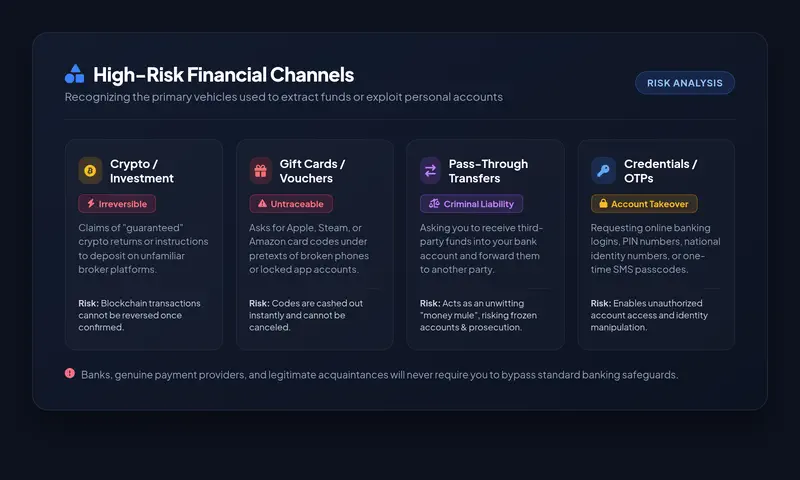
Figure 2: Overview of common payment channels and their associated risks. Once transactions leave standard banking rails, legal and financial recourse drops sharply.
What to Do If You Have Already Sent Money
If you have already transferred money or purchased gift cards and are now realizing that you may have been manipulated, do not blame yourself or allow shame to delay your response. Manipulation of this nature is sophisticated and intentionally exploits normal human empathy. What matters now is taking immediate, disciplined action.
Take these steps without delay:
Contact Your Bank or Financial Provider Immediately
Call the dedicated fraud helpline for your bank or payment app (in the UK, dial the 159 fraud hotline if your bank participates). Clearly inform them: "I believe I have made a payment under false pretences to a romance scammer." Provide transaction dates, amounts, reference numbers, and the recipient account details.
Contact the Payment Rails or Platforms Used
If you used a wire service (e.g., Western Union), a money transfer app (e.g., PayPal, Wise, Revolut), or a crypto exchange, contact their customer support immediately. If the transfer was recent, there may be a narrow window where funds can be placed on administrative hold.
Preserve All Evidence and Transaction Records
Take screenshots of all payment receipts, bank transfer confirmation screens, cryptocurrency wallet hash IDs, and gift card serial numbers. Keep the complete message histories and voice notes leading up to the request. Do not delete the chat log.
Beware of "Recovery Scams"
Once victims share their experience online or seek help on social forums, fraudulent third parties often pose as "ethical hackers" or "private asset recovery specialists" promising to retrieve lost funds for an upfront fee. No third party can hack into bank databases or blockchain ledgers. Engaging them will result in secondary financial losses.
Managing Expectations on Recovery
While banks operate under formal reimbursement codes for authorized push payment (APP) fraud in several jurisdictions (such as the UK Payment Systems Regulator framework), no platform or bank can guarantee that stolen money will be recovered. Acting swiftly gives financial institutions the best possible opportunity to mitigate losses.
Reporting the Person on Amoura
Soliciting money, advertising investment schemes, promoting cryptocurrency platforms, or requesting personal banking details is a direct violation of the Amoura Community Guidelines.
If someone asks you for money through Amoura, report them promptly so our safety moderation team can review their account:
Access the User's Profile
Navigate to the conversation or profile of the individual and tap the three-dot options icon (...) to open the report modal.
Select the Reporting Category
Choose Spam or Fake Profile or Other from the reporting reasons menu.
Provide Clear, Factual Context
In the text details area, briefly specify that the member asked for money, gift cards, or investment deposits, including any external payment usernames or links they provided.
Confirm and Block
Submitting the report will prompt you to block the user. Blocking instantly revokes their ability to view your profile, send new messages, or match with you again.
For a complete walkthrough of reporting controls and what happens after a report is submitted, see our dedicated guides on How to Report a User on Amoura, How to Block and Report Someone on a Dating App, and How Amoura Moderation Works.
If You Feel Pressured, Threatened, or Blackmailed
In some situations, refusing a financial request can cause the individual's persona to shift abruptly from warm affection to anger, aggressive harassment, or explicit blackmail (such as threatening to share private photos or sensitive personal confidences; for comprehensive response protocols, read Why You Should Never Send Intimate Photographs).
If you find yourself facing coercion or extortion, prioritise your safety by following these essential guidelines:
- Do Not Pay the Blackmailer: Paying blackmail demands rarely resolves the situation; in almost all cases, paying demonstrates that the threat works and leads to escalating financial demands.
- Do Not Engage in Arguments: Avoid retaliating, debating, or pleading with the individual. Engaging emotionally gives them additional leverage to prolong the pressure.
- Preserve the Full Threat Trail: Capture screenshots showing the demands, the account handle, timestamps, and payment instructions.
- Report Extortion to Law Enforcement: Blackmail, harassment, and coercion are serious criminal offences. If you are in the UK, report the incident directly to your local police force via 101 (or 999 in an immediate emergency) or notify Action Fraud.
Authoritative External Helplines & Guidance
If you need independent consumer guidance, support with financial fraud reporting, or emotional assistance following financial deception, access these official services:
Action Fraud (UK)
The UK's national fraud and cybercrime reporting centre. Report incidents online 24/7 or speak with an advisor by phone.
Web: actionfraud.police.uk
Take Five – To Stop Fraud
A national UK awareness campaign led by UK Finance providing straight-forward, impartial fraud advice for consumers.
Web: takefive-stopfraud.org.uk
Financial Conduct Authority (FCA)
The UK financial regulator. Check their warning list to verify if an investment firm or broker is authorized to operate in the UK.
Web: fca.org.uk/scamsmart
Citizens Advice Consumer Helpline
Provides free, confidential consumer guidance on your legal rights, contracts, and fraud reporting steps.
Web: citizensadvice.org.uk
International members can find US and global reporting bodies (such as FBI IC3 and FTC) in the Amoura Safety Centre Directory.
Frequently Asked Questions
What should I do if the person promises to repay me with interest within 48 hours?
Treat promises of swift repayment with extreme caution. Scammers routinely make elaborate repayment commitments—often claiming they have incoming inheritances, pending business settlements, or mature investments—to lower your resistance. Once funds leave your possession, those promises evaporate. Maintain your boundary regardless of promised terms.
Why do fraudsters frequently ask for gift cards instead of bank transfers?
Gift card codes (such as Apple or Amazon) function like anonymous digital cash. They can be redeemed or resold on secondary exchanges within minutes without revealing the recipient's real identity or bank account. Once a gift card PIN is provided, the value is virtually impossible to recover or trace.
Is it safe to lend money if we have had video calls and know what they look like?
No. While video calling confirms that the person matches their profile photos, it does not guarantee their financial intentions or emotional authenticity. Many romance manipulation operations involve real people appearing on video calls specifically to build credibility before introducing financial dilemmas.
What should I do if someone becomes angry or hurt when I decline to send money?
Do not apologize, debate, or try to soothe their reaction. Guilt-tripping, silent treatment, or anger are coercive tactics designed to make you feel responsible for their distress. Disengage from the interaction immediately, use Amoura's native blocking tool, and report the account to our moderation team.
Can my bank get my money back if I sent it via an authorized bank transfer?
In many jurisdictions, including the UK under the Contingent Reimbursement Model (CRM) and mandatory PSR reimbursement rules, banks assess whether victims of Authorized Push Payment (APP) fraud can receive reimbursement. However, reimbursement is not guaranteed and depends on the specific circumstances, payment rail, and timeliness of your report. Contact your bank immediately to start an investigation.