
Before You Meet: Pace, Comfort, and Pre-Date Communication
Meeting someone in the real world after connecting through an app is one of the most exciting aspects of modern dating. However, moving from digital messages to an in-person encounter should happen when both people feel genuinely ready and comfortable—not because of artificial pressure or arbitrary timelines.
Take the time to establish genuine conversational rhythm. If someone pushes for an immediate same-day rendezvous, rushes to bypass conversation, or acts frustrated when you suggest getting to know each other first, take note. Respecting personal pacing is one of the earliest indicators of emotional maturity.
Before deciding to meet, consider trying an in-app video chat. On Amoura, you can initiate a live video call directly within your conversation window without having to reveal your private phone number or personal social profiles. A short 5-to-10-minute video conversation allows both people to see each other's live facial expressions, hear vocal inflections, and confirm basic conversational chemistry.
A Video Call Confirms Rapport, Not True Identity
While in-app video calling is an excellent tool to verify that someone's real-time appearance matches their profile pictures and to test conversational flow, a video call does not constitute background verification or proof of identity. It does not replace basic personal safety practices. Always maintain sensible first-date precautions regardless of how charming someone appears over camera.
If you notice aggressive demands, inconsistencies in their stories, or refusal to respect simple boundaries, remember that you do not owe anyone an in-person meeting. For more on early warning signs, see our guide on Online Dating Red Flags You Shouldn't Ignore.
Tell Someone You Trust: The Safety Buddy Plan
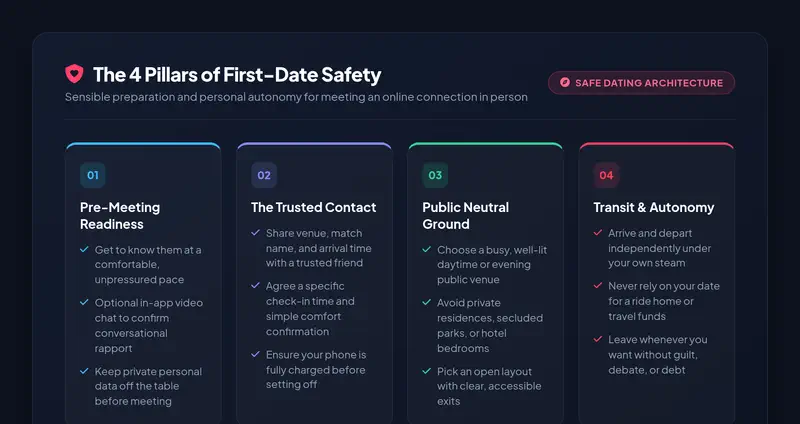
One of the simplest and most effective personal safety measures is ensuring that you are not the only person who knows your plans. Before heading out, nominate a trusted friend, family member, or housemate to be your "safety contact."
This is not about being fearful or assuming something will go wrong; it is standard adult personal safety practice, just like letting someone know if you are travelling solo or going on a hike.
Information to Share with Your Trusted Contact
- Who you are meeting: Share the person's first name, dating profile screenshot, and any verified contact details you possess.
- Where you are going: Provide the specific venue name, street address, and neighbourhood (e.g. "The Boston Tea Party cafe on Park Street, Bristol").
- Estimated schedule: Tell them roughly when the date starts and when you expect to conclude or send a check-in message.
- Agreed check-in window: Set a specific time (e.g. 45 to 60 minutes into the date) to send a quick, casual text confirming that everything is fine.
- A subtle exit code: Agree on a simple phrase (e.g. "Did you leave the spare keys?") that signals to your friend that you need them to call you with a plausible excuse so you can leave gracefully.
Before you leave home, verify that your mobile phone has sufficient battery charge (at least 70–80%) or carry a compact portable power bank. Being caught with a dead battery in an unfamiliar area removes your primary line of communication.
Choose a Sensible First-Date Location
Where you choose to meet sets the tone for your interaction and provides essential structural safety. For a first date, always insist on a busy, public, neutral venue during normal operating hours.
Ideal first-date settings include:
- Bustling coffee shops or daytime cafes: Casual, low-pressure, affordable, and naturally capped at 45 to 60 minutes if either person wants a short meeting.
- City-centre bistros, casual pubs, or casual restaurants: Plenty of staff and fellow patrons around, well-lit dining spaces, and visible entrances and exits.
- Public cultural venues: Art galleries, public museums, botanical glasshouses, or popular open-air markets provide engaging conversation prompts while remaining in full public view.
Venues to Avoid for an Initial Meeting
Politely decline suggestions to meet at private apartments, hotel suites, secluded parking areas, isolated hiking trails, or unlit countryside walks. If a date insists on meeting in a secluded location and acts defensive or annoyed when you suggest a public cafe instead, treat this unwillingness to compromise as a clear boundary issue.
Choose a location where you have easy access to public exits and restrooms. You should never feel cornered in a private back room or an isolated booth away from venue staff.
Plan Your Own Journey and Maintain Travel Independence
One of the most foundational principles of personal safety on a first date is independent mobility. You should always arrive under your own steam and possess the independent means to leave whenever you wish.
Do not allow a first date to pick you up directly from your house or drive you home at the end of the evening. While the offer may be made with generous intentions, accepting a ride creates two immediate complications:
- It reveals your exact home address: There is no need for someone you have just met to know where you live before mutual trust and comfort have been established.
- It surrenders your transport autonomy: If the date becomes uncomfortable, inappropriate, or awkward, you are trapped in someone else's vehicle or forced to negotiate a ride home with a person you wish to leave.
The Independent Transit Checklist
Always ensure you have sufficient money or a working payment app for a bus, train, or licensed rideshare (such as Uber, Bolt, or a local council-licensed black cab). Never rely on your date to fund your travel home. Keeping financial and logistical control guarantees that an early exit is always effortless.
Keep Your Personal Information Under Control
Meeting in person does not mean all privacy boundaries dissolve. What you choose to share in conversation should unfold gradually as mutual trust is earned over multiple positive interactions.
During early dates, keep conversations focused on passions, humor, hobbies, culture, and general interests. You do not need to volunteer sensitive identifying details, such as:
- Your exact street address, apartment block, or building entry codes.
- The specific company, department, or office building where you work every weekday.
- Your exact daily fitness routes, neighbourhood gym, or the precise school attended by your children.
- Your detailed financial status, personal salary, inheritance, or cryptocurrency investments.
For an in-depth breakdown of how small, seemingly innocent details can be pieced together online, read our comprehensive resource on Protecting Your Personal Information While Dating Online. If someone probes aggressively for private logistics after you deflect, treat their lack of boundary respect seriously.
During the Date: Boundaries, Behaviour, and Zero Obligation
Pay mindful attention to how your date behaves in the real world. Someone's offline conduct often reveals character far more clearly than curated dating profiles or text exchanges.
Observe how they interact not only with you, but with hospitality staff, servers, bartenders, and the people around them. Notice whether they listen attentively, respect conversational give-and-take, and honor simple boundaries.
Essential First-Date Realities to Remember
- You can leave at any time: You are not locked into a contract. If 20 minutes in you realise there is zero chemistry, you are uncomfortable, or you simply wish to be home, you have the full right to conclude the date.
- You owe no one physical contact: A handshake, hug, kiss, or any form of physical intimacy requires explicit mutual enthusiasm. You never owe physical touch because someone showed up or was polite.
- Financial generosity does not buy intimacy: If your date insists on paying for drinks or a meal, that is their personal choice. A meal or a coffee is a social gesture—it never creates a debt, an obligation for a second date, or access to your personal space.
To avoid awkward financial negotiations or guilt trips, offer to split the bill or pay for your own portion. If they insist on paying and you are happy with that, say thank you graciously, but never feel that accepting hospitality obligates you to stay longer than you wish.
Alcohol and Substances: Staying Aware and Grounded
Many first dates involve a casual drink at a pub, wine bar, or cocktail lounge. Alcohol can serve as a social lubricant, but excessive drinking or intoxication significantly impairs situational awareness, clouding your judgment and your ability to detect uncomfortable dynamics.
Keep these practical, sensible precautions in mind:
- Know your personal limits: Alternate alcoholic drinks with water, order a non-alcoholic mocktail, or limit yourself to one or two drinks during an initial date.
- Watch your drinks: Whenever possible, order directly from the bar or watch the server place the glass on your table. Never leave your drink unattended when heading to the restroom. If you return and your drink looks different, has moved, or you feel unsure, leave it and order a fresh one.
- Do not use alcohol to cope with discomfort: If you find yourself drinking heavily simply to endure awkwardness, anxiety, or someone's overbearing presence, treat that feeling as a sign to wrap up the date instead.
- Respect sobriety: Never pressure a date to drink or consume substances if they decline, and be wary of anyone who repeatedly urges you to "just have one more" after you have expressed that you have reached your limit.
If Something Feels Wrong: De-escalation and Safe Exit Protocols
Your intuition is an invaluable personal safety asset. You do not need to wait for someone to become overtly aggressive, inappropriate, or frightening before deciding to leave. A vague sense of discomfort, persistent boundary pushing, or an internal gut feeling is more than enough reason to end a date.
Here is how to handle uncomfortable situations with calm confidence:
Practical Ways to Exit Safely
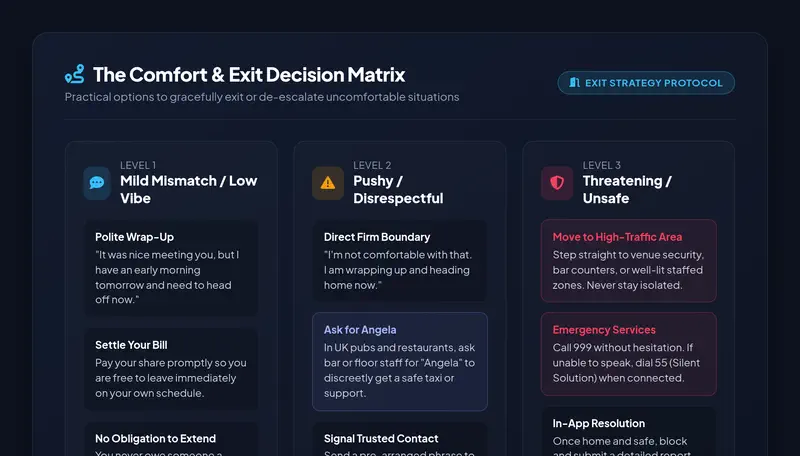
- The Simple Polite Exit: You do not need to justify yourself. A calm, direct phrase works best: "Thank you for meeting me, but I have an early start tomorrow and need to head off now." Leave your share of the bill on the table and depart.
- The Restroom Transition: If you feel uncomfortable saying goodbye at the table, excuse yourself to the restroom. Collect your coat, settle your portion of the bill with the bar staff, and step out directly to your booked transit. Send a brief polite text once safely on your way if you wish.
- "Ask for Angela" (UK Venues): In pubs, bars, restaurants, and clubs across the UK, staff are trained under the national "Ask for Angela" scheme. If you feel unsafe, harassed, or vulnerable, walk up to the bar or a staff member and ask: "Is Angela working tonight?" Staff will understand this discreet code, escort you to a safe staff area, help arrange a taxi, or escort you safely out of the venue without causing a public scene.
- Contact Your Trusted Buddy: Send your pre-arranged emergency phrase. Have them call your phone immediately, providing an instant excuse: "I'm so sorry, my flatmate has locked themselves out and needs me home right away."
- Immediate Danger / Police Assistance: If someone becomes physically threatening, corners you, follows you, or refuses to let you leave, call 999 immediately. If you are in immediate danger but unable to speak aloud without alerting someone, dial 999 and press 55 when prompted by the operator (the UK Police "Silent Solution" service).
If You Are Invited to Their Home
It is very common during a pleasant first date for someone to suggest: "Would you like to come back to my place for a coffee or a drink?"
There is no shame or judgment in consenting adults making autonomous romantic decisions. However, from a safety perspective, entering a private residence removes all public witnesses, staffed security, and immediate exit routes. You are now entirely reliant on that individual in their personal environment.
For a first date, the safest, most sensible response is a gracious decline:
A Clear, Positive Script to Decline
"I've really enjoyed this evening, but I make it a rule never to go to someone's house on a first date. Let's arrange a second date in town instead."
A considerate, respectful date will take this in stride and appreciate your clear communication. If someone responds with petulance, sulking, mockery, or tries to guilt-trip you by saying "Don't you trust me?", recognize that their response is a profound red flag. Trust is earned over time, not demanded on day one.
If you do make the personal adult decision to visit someone's home, ensure you have:
- An independent way to get home at any hour without needing them to drive you.
- Informed your trusted contact of the exact street address you are visiting.
- Sufficient phone battery and reception to call for transport or assistance if needed.
After the Date: Concluding, Following Up, and Reporting
Once you arrive safely home, take a moment to reflect on how the experience felt without overthinking:
- Close the loop with your buddy: Send a quick confirmation text letting your nominated contact know that you have arrived home safely.
- If the date went well: If you both enjoyed yourselves and felt mutual chemistry, continue communicating at a natural, comfortable pace. Read our in-depth companion guide on moving from online conversation to a real relationship to navigate next steps with confidence and care.
- If the vibe was not right: You are not obligated to continue dating someone out of pity or politeness. A simple, respectful closing message is courteous and mature: "It was really nice meeting you, but I didn't feel the romantic spark. I wish you all the best on here!" (see our advice on How to Deal with Rejection While Dating and Online Dating Etiquette).
- If they react with hostility, harassment, or stalking: Do not engage in an argument. On Amoura, you can immediately utilize the Block and Report feature located directly in the conversation menu. Select the relevant category (such as Harassment or Inappropriate Content) so our moderation team can review and take appropriate action. See our guides on How to Report a User on Amoura, How to Block and Report Someone on a Dating App, and How to Handle Suspicious or Uncomfortable Behaviour.
Frequently Asked Questions
What should I do if my date offers to pick me up from my home?
Politely decline and say: "Thanks so much for offering, but I prefer to make my own way there so we can meet directly at the venue." A reasonable person will completely understand and respect this preference. Declining preserves your home address privacy and ensures you have autonomous transport to leave whenever you wish.
Is having a video call before meeting in person necessary?
While not strictly mandatory, an in-app video call is highly recommended. It confirms that the person's real-time appearance matches their profile photos and gives you an authentic sense of their vocal tone, energy, and communication style before you invest time and travel in an in-person meeting.
How can I gracefully leave a first date early if I feel uncomfortable?
You do not need a dramatic confrontation or an elaborate excuse. A calm, decisive statement works best: "It was really nice meeting you, but I need to head off now." Settle your portion of the bill and step out. In UK pubs and restaurants where you feel threatened or unsafe, ask bar or venue staff for "Angela" to receive discreet staff assistance and a secure taxi escort.
What if my date pays for an expensive dinner or drinks—do I owe them anything?
Absolutely not. Paying for dinner or drinks is a voluntary social courtesy; it does not buy your time, your company, physical intimacy, or an obligation to go on a second date. You always have full sovereignty over your body and your time. If you prefer to prevent any perceived pressure, offer to split the bill evenly.
How should I react if someone gets angry when I decline an invitation to their home?
Anger, guilt-tripping, or mockery when you establish a reasonable personal boundary is a major red flag. Do not apologise, negotiate, or compromise your safety to appease their temper. Conclude the meeting immediately, travel home independently, and block and report their account in-app if their behaviour was intimidating or harassing.