
Why Trust Matters in Romance Scams
Popular depictions of online dating fraud often portray romance scams as clumsy, obvious schemes launched by anonymous strangers asking for money within days of matching. In reality, the most damaging forms of relational deception operate on an entirely different timeline. They depend almost entirely on establishing authentic-feeling credibility, mutual affection, and emotional trust long before any demand or irregularity ever surfaces.
Trust is the fundamental currency of human intimacy. When two people meet, vulnerability and mutual openness allow affection to take root. Romance scammers understand this dynamic intimately: they recognize that an immediate demand for money or sensitive data will almost always be rejected, whereas a request made to someone who already views them as a devoted romantic partner carries tremendous emotional leverage.
Crucially, falling victim to this form of calculated manipulation does not mean someone was foolish, desperate, or careless. Deception succeeds precisely because it mimics the warm, comforting qualities of genuine human bonding. The human instinct to trust, empathize, and support someone we care about is a healthy virtue, not a character flaw. Understanding the tactical progression behind how manipulators cultivate that trust is the most effective safeguard against having your natural empathy exploited.
Distinct Editorial Scope
While our guide on How to Recognise a Romance Scam outlines the broad operational indicators and payment mechanics of fraud, this article examines the underlying psychological and behavioural progression that makes manipulative relationships feel convincing in the early and middle stages.
The Relationship May Start Normally
One of the primary reasons people find themselves blindsided by manipulative behaviour is the assumption that a deceitful connection will feel suspicious from the very first interaction. In practice, the opening stages of a scam often feel refreshingly ordinary, respectful, and engaging.
The initial messages may touch upon standard dating topics: your favourite weekend activities, your career, shared tastes in music, or how your respective weeks are unfolding. There are no sudden requests for cash, no suspicious links, and no obvious red flags. In fact, the conversation may feel substantially more attentive and considerate than the typical, often brief banter common on modern dating apps.
It is essential to emphasize that warm conversational rapport and initial enthusiasm are not inherently suspicious. Healthy connections regularly begin with mutual excitement and engaging dialogue. The key distinction lies in what happens next: whether that connection deepens organically with balanced pacing, mutual curiosity, and grounded reality, or whether it begins a subtle, one-sided acceleration designed to bypass your normal relational boundaries.
Creating a Sense of Connection
Once preliminary rapport is established, an individual intent on building artificial trust will often focus on creating an intense, immediate sense of compatibility. In relational psychology, this is frequently achieved through deliberate mirroring and hyper-attentive listening.
Common behavioural patterns in this stage include:
- Value and Interest Mirroring: If you mention a deep love for independent films, volunteer work, or outdoor hiking, they may enthusiastically declare that these are their passions as well. Rather than bringing their own distinct, quirky perspectives, their preferences conveniently align with yours in nearly every dimension.
- Hyper-Attentive Detail Retention: They remember small, offhand remarks you made days earlier—such as an upcoming dentist appointment, a sick pet, or a challenging work project—and bring them up with genuine-sounding care. This makes you feel seen, valued, and prioritized.
- Validation of Past Relationship Pain: If you mention past relationship disappointments or loneliness, they may validate your feelings deeply, assuring you that they would never treat someone that way and that you deserve unconditional loyalty.
- The "Soulmate" Narrative: Early remarks may suggest that meeting you was serendipitous or fated, planting the seed that your bond is uniquely rare and superior to ordinary connections.
Feeling understood is one of the most rewarding experiences in dating. However, when every belief, preference, and emotional wound you voice is instantly reflected back with flawless symmetry, it is worth pausing to evaluate whether the other person is genuinely sharing themselves or simply assembling an agreeable mirror of your desires.
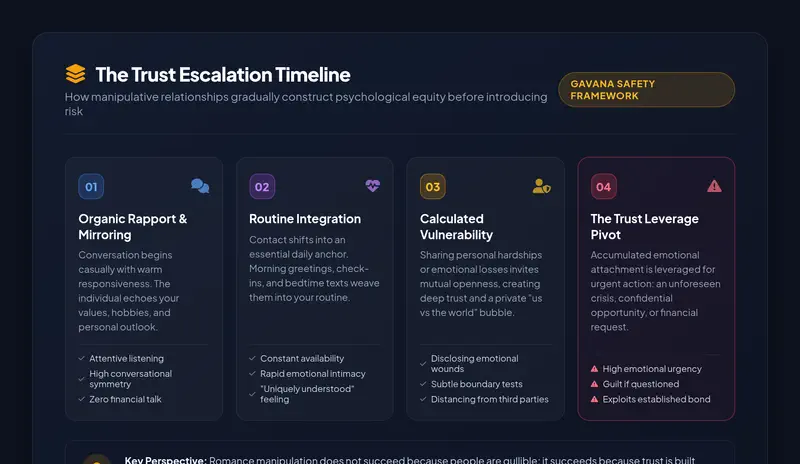
Figure 1: The four-phase trust progression model. Manipulative connections accumulate social equity and emotional familiarity before introducing demands.
Increasing Emotional Intensity
As rapport solidifies, trust-building tactics often pivot toward accelerating emotional depth at a pace far faster than normal relational milestones warrant. This rapid escalation creates a powerful psychological bond before either party has observed the other in diverse, real-world contexts.
This dynamic can manifest through several characteristic indicators:
- Premature Terms of Endearment: Calling each other pet names, professing love, or talking about deep devotion within days or weeks of messaging, before you have shared meaningful shared experiences or sustained video interaction.
- Elaborate Future-Faking: Painting detailed pictures of future vacations, cohabitation, marriage, or joint financial goals. These grand visions create an emotional investment in a shared tomorrow, making present-day irregularities easier to overlook.
- Urgent Communication Cadence: Sending multiple long messages a day, checking in constantly, and expressing sadness or disappointment if you take a few hours to respond to your phone during work.
It is critical to maintain editorial nuance here: genuine romantic connections can occasionally feel intensely exciting and fast-moving in their early weeks. Healthy fast connections, however, remain grounded in reality, respect your individual commitments outside the relationship, and do not make you feel guilty for taking space. Manipulative intensity, by contrast, feels breathless, insular, and subtly coercive.
Becoming Part of Your Daily Routine
A cornerstone of effective trust-building is habitual presence. When an individual becomes woven into the quiet, habitual rhythms of your day, their presence stops feeling like a new acquaintance and begins feeling like an irreplaceable part of your life.
This integration is often cultivated through predictable daily touchpoints:
The Morning Greeting
A thoughtful text waiting for you when you wake up establishes them as your very first conscious thought of the day, signaling dependable care and emotional attentiveness.
The Evening Confidant
Late-night conversations after a tiring day create an intimate cocoon where you decompress, vent about workplace stress, and share personal worries.
Over several weeks or months, this constant availability establishes them as your primary sounding board. Because you speak to them more frequently than many of your close friends or colleagues, your mind naturally equates high communicative frequency with high relational safety.
This familiarity produces a powerful cognitive effect: when someone has been a steady, loving voice in your ear for dozens of consecutive days, your subconscious lowers its defensive perimeter. If they eventually present an unexpected dilemma or request, your instinctive reaction will be to help someone you know intimately, rather than scrutinize someone you have never verified in person.
Building Credibility & Strategic Vulnerability
To make a persona believable, scammers do not merely present an idealized, perfect individual. Sophisticated manipulation frequently incorporates strategic vulnerability—deliberately revealing flaws, emotional pain, or personal losses to make their narrative appear authentic and evoke your protective instincts.
How this credibility is constructed in practice:
- The "Wounded Healer" Narrative: Sharing stories of past betrayal by a former spouse, bereavement, or business hardship. Showing this vulnerability signals to you that they are honest, emotionally open, and trustworthy.
- Eliciting Reciprocal Confidences: In human psychology, vulnerability is reciprocal. When someone shares a deeply private story with you, social norms make you feel compelled to share your own secrets, fears, and financial worries in return. This provides the manipulator with valuable insights into your emotional levers.
- Proactive Explanations for Peculiarities: Rather than waiting for you to ask why they cannot readily meet for coffee or why their camera is broken, they weave natural-sounding justifications directly into their backstory—such as an overseas contract, military deployment, engineering post, or medical residency.
- Selected "Proof" Tokens: Sending candid everyday photos (such as a meal, a pet, or a work desk) that match their stated location and daily schedule, creating an illusion of full domestic transparency.
Authentic vulnerability in dating develops reciprocally and gently over time as real-world trust is earned. When intense disclosures of trauma or financial upheaval occur very early in digital messaging, treat it not as proof of deep honesty, but as a potential tactic to force intimacy before mutual history exists.
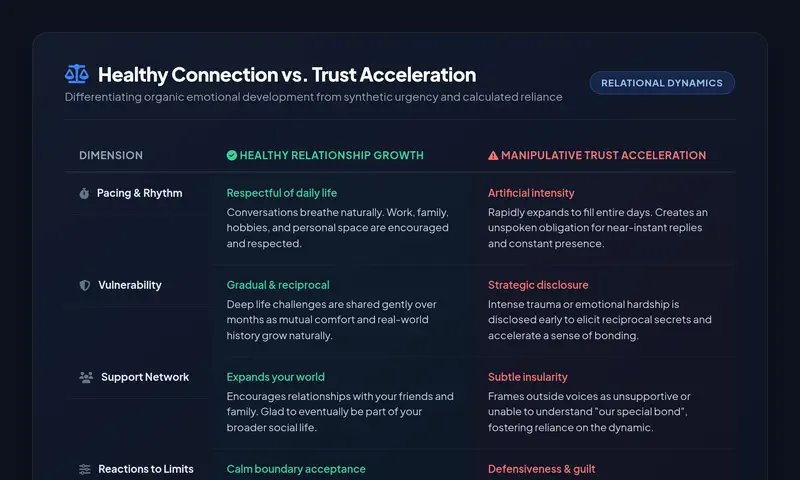
Figure 2: Evaluating relational development. Healthy relationships support your broader life and autonomy, whereas manipulative dynamics prioritize insularity and urgency.
Creating Distance Between You and Other Perspectives
An essential step in consolidating psychological control is diminishing the influence of third-party perspectives. If your family, friends, or coworkers hear about the relationship, their objective, detached viewpoint might spot inconsistencies that you cannot see through the haze of infatuation.
Scammers rarely demand that you cut off your loved ones outright; such an overt demand would trigger immediate alarm. Instead, they apply gentle, subtle distancing techniques:
- "They Won't Understand Us": Framing your relationship as so uniquely transcendent or intense that ordinary friends or relatives will simply be jealous, cynical, or unsupportive.
- Praising Absolute Confidentiality: Framing secretiveness as romantic privacy: "Let's keep what we share between just the two of us until we're together in person."
- Subtle Critiques of Your Circle: Suggesting that your friends do not truly value you, do not prioritize your happiness, or are holding you back from experiencing true love.
By creating a private bubble where only their voice and validation matter, the manipulator shields the connection from outside reality checks. If you find yourself hesitant to mention the details of an online relationship to people who have known and loved you for years, ask yourself why secrecy feels necessary.
The Turning Point: When Equity Is Leveraged
Every phase of rapport-building, routine integration, and vulnerability leads up to a singular juncture: the turning point. This is the moment when the accumulated emotional equity is mobilized to extract something tangible.
Because trust has been painstakingly cultivated over weeks or months, the request does not present itself as a transactional demand. Instead, it arrives dressed as an unavoidable crisis, an extraordinary mutual opportunity, or a critical test of emotional solidarity:
- A Sudden, Time-Sensitive Emergency: A detained shipment, an unexpected medical bill for a dependent, customs fees for travel documents to visit you, or frozen bank accounts while traveling.
- A Lucrative Investment Opportunity: Introducing a "confidential" cryptocurrency platform, currency exchange, or business venture they claim to use successfully, offering to "help you invest" so you can build a joint future together.
- A Request for Accounts or Transfers: Asking you to receive funds on their behalf, forward packages, or open accounts because of banking restrictions in their location.
Notice the psychological leverage at play: refusing the request feels to the victim like abandoning a romantic partner in their moment of desperate need. The manipulator will often respond to hesitation not with anger, but with profound hurt: "After everything we've shared, I thought you trusted me."
Detailed Financial Defense
For specific protocols on how to handle requests for money, wire transfers, crypto investments, or account access, refer to our comprehensive guide on What to Do If Someone Asks You for Money and review our core Romance Scam Guide.
Why It Can Be Difficult to See While You're In It
From the outside, friends and family often wonder how someone could fail to spot the warning signs. From the inside, however, the psychological reality is vastly different. Understanding why manipulation is so difficult to see from within helps dismantle the shame that often keeps victims silent.
Key psychological forces at work include:
- The Principle of Incremental Commitment: Scammers do not ask for a massive leap on day one. They ask for an extra five minutes of conversation, then a personal story, then a minor favour, then a larger commitment. Each step feels only incrementally different from the last, normalizing the dynamic over time.
- Cognitive Dissonance and Protective Hope: Admitting that someone you love is deceiving you requires accepting that the connection was an illusion, your emotional vulnerability was exploited, and your future dreams are gone. The human brain naturally resists this painful realization, preferring to believe plausible-sounding excuses instead.
- Isolation from Grounded Feedback: When outside perspectives have been minimized, there is no one nearby to counter the manipulator's narrative or validate your lingering gut doubts.
- Fear of Social Judgment: People who begin suspecting something is amiss often conceal their worries out of fear that friends or family will criticize them for being foolish.
If you ever find yourself questioning whether an online connection is manipulating you, remember: questioning the situation is a sign of healthy self-awareness, not a betrayal of love.
Grounded Practices to Keep Perspective
Protecting yourself while dating online does not require becoming cynical, closed-off, or suspicious of everyone you meet. It simply requires adopting grounded, reality-testing habits that allow genuine connections to thrive while filtering out artificial manipulation.
Anchor Your Outside World
Never allow a new online romance to replace your existing support system. Keep talking to close friends and family, and mention your dating life openly. If a relationship requires total secrecy, that is a warning sign.
Insist on Grounded Verification
Use in-app video calling early in the connection. On Amoura, live video calls help ensure the person messaging matches their profile imagery before emotional attachment deepens. Reluctance to participate in a brief video call warrants serious pause (see our guides on Profile Verification & Authenticity and How to Spot a Fake Dating Profile).
Honor the Pause When Urgency Strikes
Manipulators rely on creating sudden emotional emergencies to short-circuit logical analysis. Implement an unbreakable rule: whenever a new contact introduces an urgent financial or legal dilemma, step back for 24 hours and consult a trusted friend.
Maintain Hard Boundaries
Decide in advance that you will never send money, gift cards, crypto assets, or personal identity documents to someone you have never met in person, regardless of how tragic their circumstances sound or how long you have messaged.
If You Think Someone Is Manipulating You
If you realize that an online acquaintance has been building artificial trust to exploit you, it is vital to respond calmly, safely, and decisively. You do not need to stage a dramatic confrontation or demand an explanation.
Pause Communication Immediately
Do not confront the person with accusations. Confrontation provides a skilled manipulator with an opportunity to deploy guilt, gaslighting, or elaborate counter-stories to draw you back into the dynamic. Simply stop replying and step back.
Preserve Messages and Evidence
Take screenshots of chat histories, shared photos, phone numbers, payment addresses, or external handles before deleting conversations or blocking accounts. If law enforcement or platform moderation needs to review the interaction, this documentation is essential.
Talk to Someone You Trust in the Real World
Break the silence. Speak to a trusted family member, close friend, or counsellor. Sharing the experience aloud with someone detached from the romance helps release the emotional pressure and brings objective clarity.
Report and Block on Amoura
Use Amoura's native profile tools to submit a report under Spam or Fake Profile or Other, providing a brief factual summary of the behaviour. Then block the account immediately to prevent any further contact. Review our complete walkthrough on How to Report a User on Amoura and How to Block and Report Someone on a Dating App. To learn more about identifying manipulative warning signs, see Online Dating Red Flags You Shouldn't Ignore.
Contact Financial Institutions and External Helplines
If money or financial credentials were shared, notify your bank or card issuer immediately to freeze compromised accounts or dispute pending transfers. If you reside in the UK, report the incident to Action Fraud (0300 123 2040), or in the US to the FBI IC3 and FTC. Additional crisis and consumer resources are accessible via the Amoura Safety Centre External Directory.
Frequently Asked Questions
How long will a romance scammer spend building trust before asking for money?
There is no fixed schedule. While automated spam accounts may make clumsy requests within forty-eight hours, human romance scammers frequently invest several weeks, and in some documented cases many months, cultivating rapport before introducing a financial request. The timeline is tailored to the victim's perceived attachment and financial stability.
Why do scammers often want to move the conversation off the dating app quickly?
Moving off-platform to private messaging apps or email accomplishes two goals for a manipulator: it removes their interactions from platform safety moderation and automated pattern detection, and it transitions the communication into an environment where they can message you continuously alongside your personal contacts, accelerating routine integration.
Does attentive listening and remembering details always indicate manipulation?
No. Attentive listening and thoughtful recall are hallmarks of caring, emotionally intelligent human partners. The concern is not attentiveness in isolation, but how it pairs with other patterns: such as flawless echoing of all your values, reluctance to verify identity via live video, rapid declarations of destiny, and subsequent requests for financial assistance.
What should I do if a match becomes upset when I set a boundary or decline to share personal info?
Pay close attention to how someone responds to "no." A genuine connection will respect your personal comfort, apologize if they made you uncomfortable, and easily adapt to your chosen pace. Guilt-tripping, defensiveness, or questioning your affection in response to a healthy boundary indicates an attempt to exert emotional pressure.
Can romance scammers operate video calls or send voice notes?
Yes. While many avoid live video by claiming poor internet, strict workplace rules, or damaged cameras, some perpetrators will send pre-recorded clips, use brief low-resolution video calls, or employ voice notes to enhance credibility. While live, interactive video calls significantly reduce risk, holistic consistency over time remains the gold standard of authenticity.