
Creating a Two-Way Conversation (Not an Interview)
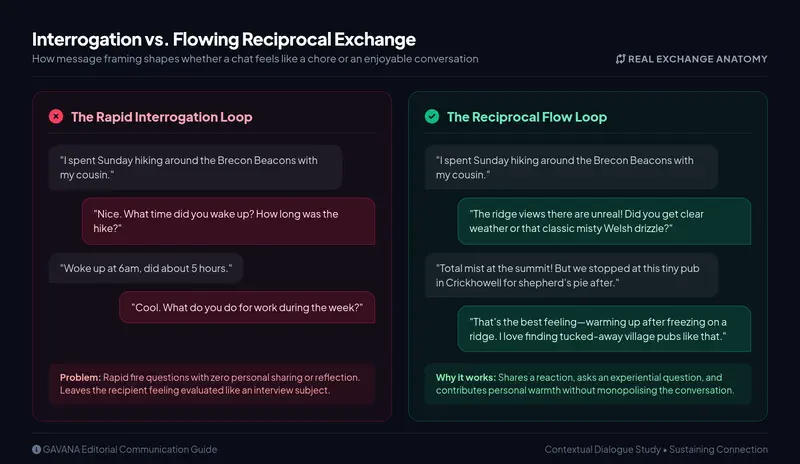
Once you have broken the ice with an engaging opening message (as covered in our guide on How to Start a Conversation on a Dating App), the next challenge begins: keeping the interaction flowing naturally. Many online dating exchanges stall within the first few exchanges not because of a lack of attraction, but because the conversation falls into one of two common traps: the interrogation loop or the one-sided monologue.
In an interrogation loop, one person fires question after question: "Where do you live?", "What do you do for work?", "Do you have siblings?". While polite, this pattern forces the recipient into an interview chair. Conversely, in a one-sided monologue, one person shares extensive paragraphs about their own life without ever asking how the other person experiences the world.

A healthy dating conversation resembles a gentle game of tennis rather than an interrogation or a lecture. One person sends the ball over the net with an observation or story, the other person receives it, adds a bit of spin with their own perspective, and returns it with an invitation to continue.
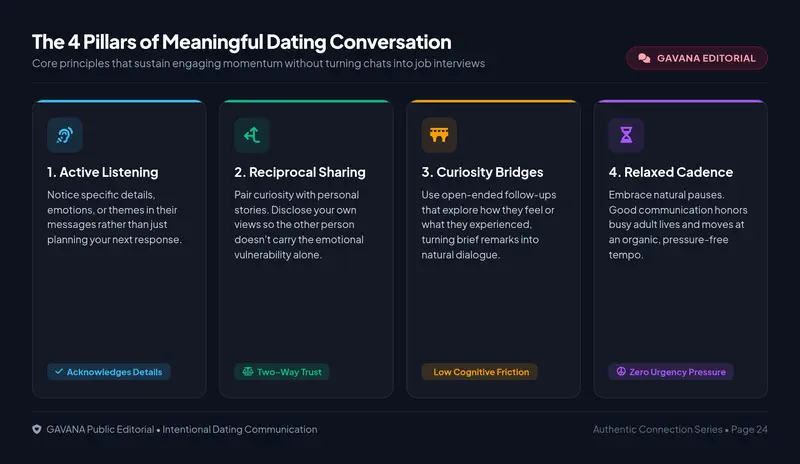
Turning Short Answers Into Natural Flow
When matches reply with brief answers, many people assume they are disinterested and either give up or fire another stiff question. Often, a brief answer simply means they aren't sure where to take the conversation next. You can gently open up the space by validating what they said and connecting it to a sensory detail:
Expanding on Brief Remarks
Match says: "My week has been really hectic."
Stiff response: "Why, what happened?" (Puts them on the spot to recount stressful work logistics)
Conversational turn: "I hear you—those weeks where Monday feels like a marathon can be exhausting. Are you able to unplug completely this weekend or do you have to stay on call?"
Why it works: It demonstrates empathy, validates their feeling, and shifts the topic toward weekend relief rather than demanding an administrative breakdown of their workload.
Listening and Showing Genuine Interest
True listening in dating is not simply waiting for your turn to speak—it is paying close attention to what the other person actually values, worries about, or finds fascinating. In digital messaging, this means catching the subtle details embedded in their responses and weaving them into your replies.
When someone mentions in passing that they were making soup from scratch, helping their younger sister move apartments, or re-watching an old comedy film, they are handing you conversational bookmarks. Acknowledging those bookmarks shows that you see them as a whole person rather than just another profile on a screen.
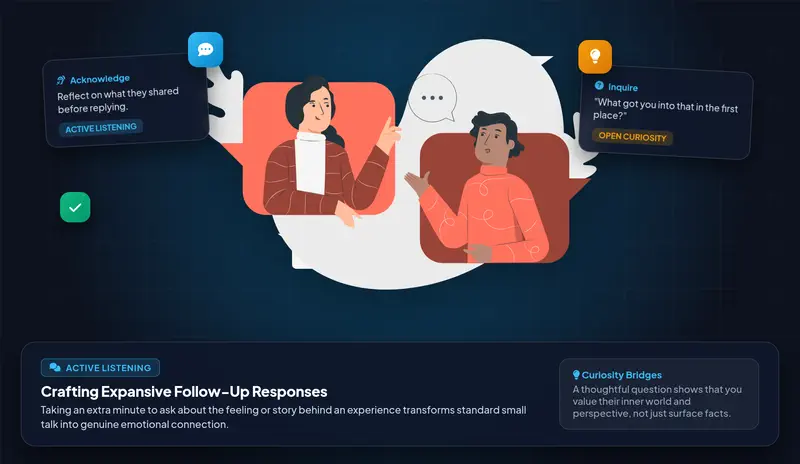
The Acknowledge-Reflect-Inquire Structure
One reliable way to demonstrate active listening in messages is the three-step flow:
- Acknowledge: Repeat or validate the core element of what they said (e.g., "Helping family move is always an adventure...").
- Reflect: Share a brief emotional reaction or light opinion (e.g., "...especially when trying to navigate stairwells with oversized furniture.").
- Inquire or Bridge: Ask how the experience felt or what came after (e.g., "Did you at least get rewarded with celebratory pizza at the end?").
Asking Expansive Questions Naturally
The difference between a conversation that feels vibrant and one that peters out often comes down to question framing. Closed questions invite single-word answers ("Yes", "No", "London"), leaving the conversation with no forward inertia. Expansive questions invite stories, opinions, and feelings.
However, asking expansive questions does not mean every message must conclude with a interrogation mark. Conversational rhythm requires alternating between questions, observations, and casual shared laughter.

Expansive Questions Across Different Topics
Travel & Places
Instead of: "Where was that photo taken?"
Arts & Entertainment
Instead of: "Do you like movies?"
Everyday Routines
Instead of: "What are you doing today?"
Balancing Curiosity With Personal Sharing
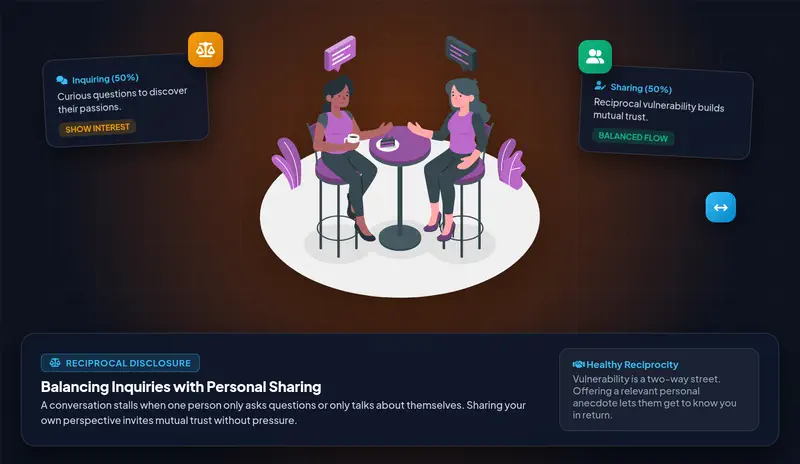
Vulnerability and trust must develop in parallel. If you only ask questions without revealing anything about yourself, your match may feel scrutinised. Conversely, if you share deeply personal life struggles or financial stresses in early messages, you risk creating discomfort before emotional rapport exists.
Healthy dating communication relies on proportionate self-disclosure. When you ask about their favourite weekend activities, pair it with a brief, genuine anecdote about your own:
Pacing Personal Disclosure
Early conversations are meant to explore compatibility, humour, and mutual interests. Avoid discussing past relationship grievances, sensitive family conflicts, or detailed financial situations until genuine trust has been established over time.
Finding Common Ground (and Appreciating Differences)
Discovering that you and your match both love independent cinemas, hiking in the countryside, or specialty filter coffee provides an immediate conversational spark. Shared passions give both of you an effortless topic to explore.
However, one of the most common dating pitfalls is feeling pressured to pretend you love everything your match likes. If they are passionate about rock climbing and you have never climbed in your life, you do not need to feign expertise. In fact, showing authentic, respectful curiosity about something unfamiliar is often more appealing:

Responding to Unfamiliar Passions
They say: "I spend most Saturdays working on ceramics at an open studio."
Weak response (pretending): "Oh yeah, I love pottery, it's so easy!" (Dishonest and bound to fail later)
Engaged, authentic response: "I've never touched a pottery wheel, but watching people throw clay looks almost meditative. What got you into it, and what's the hardest piece you've made so far?"
Why it works: It honours their skill, validates their enthusiasm, and allows them to teach you about something they genuinely care about.
Handling Different Communication Styles
Adults communicate in diverse ways. Some people write lengthy, expressive paragraphs with exclamation marks and emojis; others are concise, measured, and send two sentences at a time. Some check dating apps throughout the day, while others log in once each evening after their workday ends.
Recognising that communication styles vary saves significant emotional energy:
- Conciseness is not necessarily disinterest: A brief message from a busy professional might indicate focus, not rejection. Look at whether they answer thoughtfully and ask questions back.
- Response tempo reflects offline life: Delays between messages often mean demanding work deadlines, family commitments, or social events. Resist the urge to invent negative narratives (see our guide to Online Dating Etiquette and advice on How to Deal with Rejection While Dating).
- Humour registers differently in text: Dry wit or irony can easily be misread without vocal inflections. Keep early humour gentle, warm, and self-evident.
Moving Beyond Small Talk Without Pushing Boundaries
Small talk serves an important purpose: it is the social foyer where two strangers establish safety and baseline rapport. However, lingering in small talk for weeks—exchanging only "How was your Tuesday?"—inevitably drains momentum.
Transitioning deeper does not require asking probing or uncomfortable questions. It simply means shifting the focus from what happened to how they experienced it:
| Surface Small Talk | Meaningful, Comfortable Bridge |
|---|---|
| "How was work today?" | "What is the part of your job that you genuinely look forward to, and what's the part you wish you could outsource?" |
| "Where do you live?" | "What made you choose your neighbourhood? Is there a local spot you consider your secret go-to?" |
| "What do you do for fun?" | "If you had an entire Saturday with zero obligations and no phone notifications, how would you spend it?" |
When conversations feel natural and mutual interest is obvious, you may consider whether to arrange a voice call or meet in person. For thoughtful guidance on when it makes sense to transition communication outside the app, consult our focused guide on When Is It Safe to Move a Conversation Off a Dating App?.
Awkward Pauses and Fading Conversations
Every active dater experiences conversational pauses. A chat that was flowing smoothly for two days suddenly slows down, or a question remains unanswered for twelve hours.
It is crucial to understand that conversational lulls are normal. In face-to-face conversations, people naturally pause, look around, and take sips of their drink. In digital communication, a pause is rarely a crisis—it is simply the space where daily life happens.

How to Respond When Momentum Slows
- Give it room: Avoid following up after two hours with passive-aggressive messages like "Guess you vanished!" or question marks. That creates immediate pressure and drives people away.
- Re-enter with an easy observation: If two or three days have passed, you can re-open the dialogue with a low-stakes remark about something interesting you encountered: "Hey! Saw this indie bookstore today and remembered your reading list. Hope you’re having a smooth week."
- Recognise one-sided effort: If you find that you are the only one initiating topics, asking questions, and keeping the conversation afloat, give yourself permission to step back. True connection requires mutual investment. If they let the conversation lapse, accept it gracefully and move forward.
Humour, Warmth, and Communicating in Your Voice
Online dating advice often encourages people to adopt rigid personas—acting aloof, excessively sarcastic, or calculatedly mysterious. In reality, calculated personas are exhausting to maintain and attract people who resonate with an illusion rather than the real you.
The most magnetic quality in dating conversation is warm, grounded authenticity:
Communicate in Your Natural Voice
If your natural humour is playful and silly, let that show. If you are quiet, thoughtful, and analytical, express your curiosity through thoughtful observations. Authentic communication acts as a natural filter, attracting partners who genuinely appreciate who you are. For advice on reflecting this honesty throughout your presence, read our guide on How to Create an Honest Dating Profile and selecting authentic profile photos.
Remember that dating conversations are not exams where every message is scored. They are explorations between two adults discovering whether their rhythms, values, and senses of humour align. Approach each interaction with open curiosity, respect their boundaries, and enjoy the process of getting to know someone new.
Frequently Asked Questions About Dating Conversations
How quickly should I reply to messages on a dating app?
Reply when you have the time and attention to write a thoughtful response. There is no need to play artificial waiting games (such as waiting four hours on purpose), nor is there any expectation to reply within seconds during a busy workday. A natural, consistent rhythm—such as checking messages during a lunch break or in the evening—communicates respect without creating pressure.
What should I do if the conversation feels like a job interview?
Break the pattern by steering away from logistical resume questions. Instead of answering with just your job title or hometown, add a sensory or emotional detail: share what surprised you about your week, a favourite hobby, or a lighthearted preference debate. Answering with a brief story invites the other person to relax and drop their interview posture.
How do I know if someone is actually interested or just being polite?
Look for reciprocal curiosity. Someone who is interested will usually ask questions in return, share details about their day, and contribute to moving the conversation forward. If someone gives short, one-word replies over several days without asking anything about you, they may be polite but unengaged, and it is healthy to invest your energy elsewhere.
Is it okay to use voice notes or audio messages?
Voice messages can convey warmth, inflection, and personality that text cannot always capture. However, before sending long audio clips, ensure you have established good rapport, or check in casually first: "Mind if I send a quick voice note?" This respects their situation if they are in an environment where listening to audio is inconvenient.
How long should we chat before asking to meet in person?
There is no universal calendar rule, but many adults find that a few days of engaging, consistent conversation (around 15 to 30 thoughtful message exchanges) provides enough signal to determine baseline comfort and shared interest. Suggesting a low-pressure, daytime public meet-up (like coffee or a museum walk) keeps things comfortable and safe for both parties (for meeting guidance, read How to Have a Safe First Date).
What if I run out of things to talk about?
You do not need an endless stream of novel topics. Feel free to reference everyday occurrences: an interesting podcast you heard, a quirky neighbourhood bakery you walked past, or weekend plans. You can also allow the conversation to naturally pause for a day or two and pick back up when something genuinely interesting crosses your path.