
What Is a Fake Dating Profile?
A fake dating profile is an account created with fabricated, stolen, or heavily misrepresented biographical information, imagery, or intentions.
People create misleading dating profiles for various reasons. Some are automated bots designed to direct traffic to commercial websites. Others are operated by individuals seeking emotional validation or playing elaborate pranks under a borrowed identity. In more serious instances, deceptive profiles are created as vehicles for financial fraud, extortion, or impersonation.
However, it is crucial to start with an open, balanced mindset: an unusual detail or an awkward answer does not automatically mean a profile is synthetic or malicious. Real human beings are imperfect. Someone might take poor photos, feel shy when writing a bio, or reply slowly because of a demanding job. Developing discernment means learning to recognise clusters of meaningful inconsistencies over time, rather than jumping to suspicious conclusions from a single detail.
Specialist Scope & Boundaries
This guide focuses specifically on how to spot potentially fake or misleading profiles. For detailed explanations of emotional manipulation and financial fraud, read our dedicated guide on How to Recognise a Romance Scam. For a deeper look at identity misrepresentation where someone adopts an entirely fictional persona for companionship, explore our dedicated guide on Catfishing: What It Is and How to Avoid It.
What Makes a Dating Profile Look Suspicious?
When a profile is constructed deceptively, small fissures often appear between the persona being projected and the practical realities of daily life. While none of these traits individually proves deception, they warrant thoughtful observation:
1. Glossy, Impersonal, or Inconsistent Imagery
Every photo looks like an editorial shoot from a high-fashion catalog, a modeling portfolio, or a commercial stock gallery. There are no candid shots, no casual outdoor activities, and no relaxed photos with friends or pets. Alternatively, the person's apparent age, hair color, or physical build fluctuates noticeably between photographs.
2. Vague Bios Filled With Recycled Quotes
The "About Me" section consists solely of generic inspirational aphorisms (e.g. "Living life to the fullest, honest and caring soul looking for true love") without mentioning any specific hobbies, local neighborhood spots, personal tastes, or tangible lifestyle details.
3. Disconnect Between Stated Location and Local Awareness
Their profile lists their city as Manchester or Chicago, but they exhibit no familiarity with familiar landmarks, local weather, or neighborhood customs. When asked about local spots, they often claim they are "currently away on an extended overseas engineering assignment" or "traveling for international business."
4. High Urgency to Migrate Off the App
Within a handful of messages, the person insists on shifting communication to external, unmonitored channels—such as WhatsApp, Telegram, or private email—claiming they "rarely check this app" or "prefer more private messaging."
5. Career Claims That Don't Match Everyday Availability
They describe holding a demanding executive, military, or offshore professional position, yet they are available to message continuously throughout all hours of the day and night.
Look at the Whole Profile, Not One Sign
Human beings are naturally complex and varied. Someone might have professional headshots because their employer required them for work. Someone else might keep their bio brief because they are genuinely private or unsure what to write.
That is why effective discernment relies on a holistic evaluation framework. Rather than treating a single detail as a definitive verdict, examine how multiple dimensions fit together across their photos, biography, conversational alignment, and willingness to verify themselves.
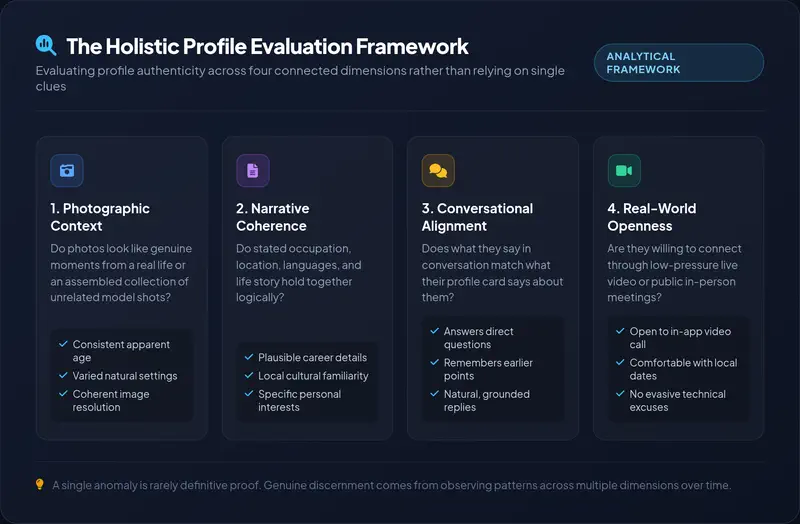
Figure 1: The Holistic Profile Evaluation Framework illustrates how assessing visual, biographical, and conversational signals together provides reliable discernment.
When evaluating a candidate, ask yourself:
- Do their lifestyle photos support their bio claims? If someone lists outdoor trekking as their main passion, do any photos reflect natural outdoor environments, or are they all taken inside luxury hotels?
- Does their communication voice match their written persona? If their profile bio is written in formal, literary English, does their conversational tone align with that voice, or does it feel completely disjointed?
- Is there room for natural human imperfection? Real profiles usually contain minor quirks—a slightly blurred candid vacation photo, a funny self-deprecating comment, or an ordinary snapshot in a local park. Synthetic accounts often appear oddly sterile or overly polished.
Photos Can Provide Clues — But They Are Not Proof
Photographs are often the first thing people analyze when questioning an account's authenticity. While imagery can offer helpful clues, photos alone should never be treated as definitive proof of identity.
Sensible Visual Nuances to Look For
- Lighting and Setting Diversity: Genuine members typically share photos taken in different lighting conditions, at different times of the year, wearing different wardrobes. A fake profile constructed from stolen modeling images often shows the person in the exact same setting, lighting, and hairstyle across every uploaded image.
- Image Resolution and Compression Artifacts: If photos are heavily pixelated, cropped unusually tightly, or show visible compression artifacts around watermarks, they may have been re-saved from social media accounts or magazine websites.
- AI-Generated Artifacts: Emerging synthetic imagery may display subtle irregularities—such as mismatched earrings, warped eyeglasses frames, blurred fingers, asymmetrical teeth, or strangely melting background structures.
Why Beautiful Photos Do Not Prove a Profile Is Fake
It is equally important to avoid cynically assuming that exceptionally attractive or professional photography automatically indicates deception. Many genuine dating app members:
- Hire professional dating portrait photographers to put their best foot forward.
- Work in creative, modeling, fitness, or media industries where high-grade imagery is standard.
- Use modern smartphones with portrait lenses and subtle retouching tools.
Treat high-quality photography as an invitation to engage thoughtfully, not as grounds for immediate suspicion.
A Note on Reverse Image Search
Tools like Google Lens can occasionally reveal if an image originated on a public stock agency or an influencer's public page. However, image search is not infallible: private photos stolen from locked social accounts may not appear, while genuine people whose photos appear on their company's "About Us" page will show search hits. Use image search as an informative secondary check, never as sole judge.
Pay Attention to Consistency Across Conversation
The clearest differentiator between an authentic member and a fabricated persona is conversational consistency. Maintaining a fictional identity requires constant cognitive effort; over time, fabricated claims tend to break down under natural conversation.
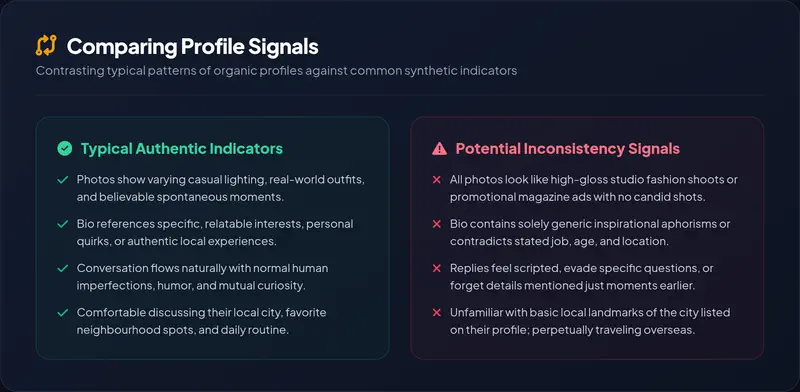
Figure 2: Side-by-side comparison of typical authentic profile nuances versus common synthetic patterns.
Observe how the person communicates during regular chats:
- Reciprocal Curiosity: Do they ask about your day, respond to the nuances of what you shared, and share details about their own routine? Automated bots and low-effort scammers often deflect questions or reply with non-sequiturs that ignore your previous message.
- Memory Consistency: Do they remember what they told you earlier in the week? If someone claimed to be a software developer on Monday, but casually mentions their hospital nursing shift on Thursday, pay attention to the contradiction.
- Real-Time Local Fluency: Can they converse naturally about local topics—such as a recent rainy weekend, a well-known local festival, or a popular downtown transit line? Synthetic accounts run from overseas often falter when asked casual, hyper-local questions.
Common Behavioral Patterns of Deceptive Profiles
Beyond profile text and photos, fabricated accounts often reveal themselves through specific conversational pacing and behavioral patterns:
- Rushed Intimacy: Progressing from a casual greeting to declarations of special destiny or profound love within 24 to 48 hours. This tactic is used to bypass critical thinking and establish rapid emotional leverage.
- Deflection When Asked Simple Questions: When asked straightforward questions about their neighborhood, their education, or what they did that morning, they provide vague answers and quickly redirect the conversation back to you.
- Reluctance to Verify Identity: When invited to join an in-app video call or meet for a low-stakes 20-minute coffee in a busy public café, they offer repeated, elaborate technical excuses.
When behavioral manipulation crosses into financial requests, emergency loans, or investment schemes, the behavior moves into active fraud. For an extensive examination of these tactics, consult our dedicated guides on How to Recognise a Romance Scam and What to Do If Someone Asks You for Money. For broader dating app dynamics and boundaries, see our guide on Online Dating Red Flags You Shouldn't Ignore.
What You Can Do If You Are Unsure
If you encounter a profile that feels inconsistent or raises doubts, you do not need to launch an investigation, confront the person, or make public accusations. Adopt a calm, protective approach:
Slow Down the Pace
Do not let intense messaging or urgent flattery push you into artificial intimacy. Maintain a grounded, measured pace that allows you to evaluate the connection objectively.
Keep Conversations on the Platform
Stay within Amoura's built-in messaging interface. Refuse pressure to migrate to WhatsApp or Telegram until you have firmly established trust and verified authenticity.
Suggest a Quick In-App Video Call
Use Amoura's integrated video call feature () inside the chat header. A 2-minute live video conversation is a friendly, low-pressure way to confirm that the person matches their profile photos. If they refuse repeatedly without valid reasons, treat it as a significant signal.
Guard Confidential Personal Data
Never share your home address, workplace location, financial details, or intimate media with anyone you have only met online.
To understand how Amoura handles account authenticity baseline signals, visit our comprehensive overview of Profile Verification & Authenticity.
If a Profile Turns Out to Be Fake
If an interaction confirms that a profile is fabricated, deceptive, or misrepresenting someone else's identity, do not argue, insult, or attempt to "unmask" the operator. Confronting a fraudster rarely yields an honest confession and often prompts them to invent new excuses or delete their account before evidence is gathered.
Submit an Incident Report on Amoura
Tap the options menu on their profile card or chat header and select Block / Report User. Choose the category Spam or Fake Profile, provide any helpful context (e.g. "Profile photos appear stolen; user refused video call and gave contradictory location details"), and ensure Also Block this user immediately is checked.
For a complete walkthrough of reporting mechanisms, read: How to Report a User on Amoura.
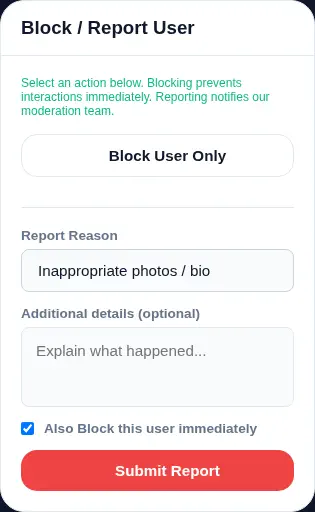
Figure 3: Submitting a report under "Spam or Fake Profile" notifies our safety moderation team for review and instantly severs communication.
Once reported, the account enters our safety moderation triage. If violations of our Community Guidelines are verified, moderators take appropriate enforcement actions, including profile suspension or permanent hardware banning. For insights into how our team reviews reports, see How Amoura Moderation Works.
Frequently Asked Questions
Does having only professionally shot photos mean a profile is fake?
No. Many genuine people hire professional dating photographers, work in creative fields, or have friends who take high-quality portraits. Professional photography is simply a reason to look for other natural lifestyle indicators, not automatic proof of deception.
What is the difference between a fake profile and a catfishing situation?
While both involve deception, "fake profiles" is a broader term covering automated spam bots, commercial solicitations, and financial scams. "Catfishing" specifically refers to a real person who adopts an entirely fabricated persona to create an emotional or romantic relationship, often driven by personal insecurity, loneliness, or escapism rather than monetary fraud.
Can AI-generated photos be detected with the naked eye?
Sometimes. AI-generated portraits often exhibit telltale flaws: oddly blurred earlobes, mismatched jewelry, unnatural teeth symmetry, garbled text on clothing or signs, or weirdly melting background textures. However, as generative tools improve, visual inspection alone becomes less reliable, making conversational consistency and live video verification far more valuable.
Why would someone create a fake profile if they aren't asking for money?
People operate fake accounts for reasons beyond financial theft: loneliness, low self-esteem, curiosity about how matches perceive a different demographic, testing a partner's fidelity, or collecting personal gossip. Regardless of motive, deceptive representation violates platform trust.
Should I confront or accuse someone if I suspect their profile is fake?
No. Confronting a suspicious account is rarely helpful. If the person is genuine, an aggressive accusation harms a potential connection; if they are deceptive, it alerts them to modify their cover story or target someone else. Simply cease contact, use the Block / Report feature, and let moderation handle the investigation.
How does Amoura help curb fake profiles during onboarding?
Amoura requires chronological date-of-birth validation, mandatory email verification with a 6-digit one-time code, and an authoritative 2-photo minimum before any member can access the Discover feed. While digital checks cannot guarantee human sincerity, these barriers effectively eliminate faceless accounts, zero-effort automated scripts, and bulk dummy profiles.