
Your Discomfort Is Valid on Its Own
When dating online, it is easy to second-guess yourself. You might receive a message that rubs you the wrong way, ask yourself if you are being "too sensitive," or feel an urge to give someone the benefit of the doubt even as your gut signals that something is amiss.
Here is the central truth to keep in mind: you do not need to prove that someone's behaviour is objectively malicious or illegal before deciding you are uncomfortable.
Online dating is not a courtroom. You are under no obligation to establish a burden of proof, build a legal case, or convince the other person that their conduct is unreasonable. If an interaction feels pressuring, intrusive, erratic, or simply uncomfortable, that feeling alone is a completely sufficient reason to slow down, stop replying, set a firm limit, or walk away entirely.
Autonomy Over Politeness
Politeness should never come at the expense of your emotional peace or personal safety. You never owe an explanation or an apology for prioritizing your comfort.
Trust Your Boundaries: Awkwardness vs Concerning Conduct
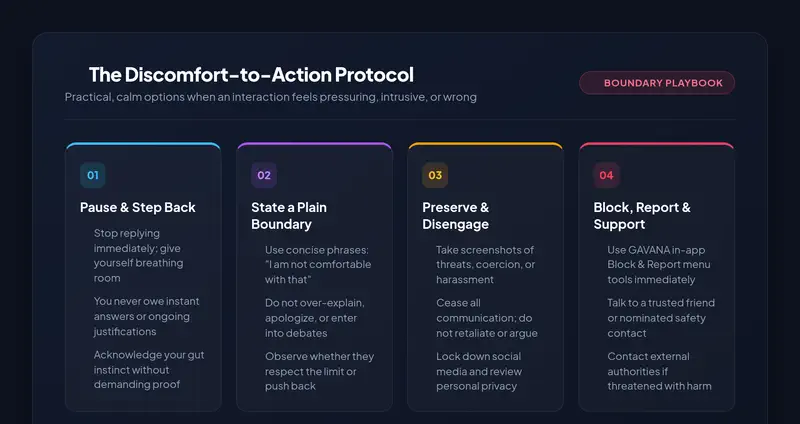
It is equally helpful to understand that not every odd interaction signals malice. Many genuine adults experience social anxiety, write clumsy opening lines, or take hours to answer because they are busy at work. Distinguishing between harmless awkwardness and concerning boundary erosion helps you respond with clarity rather than unnecessary panic.
The difference usually comes down to how they respond when a limit is established:
- Normal Awkwardness: Someone might say something slightly clumsy, tell a joke that falls flat, or take a day to reply. However, when you state a preference (e.g. "I'd rather keep chatting here for now"), they respect it immediately: "Of course, totally understand!"
- Concerning Boundary Crossing: Rather than respecting your limit, the person pushes against it. They argue, ask "Why not?", pout, double-text repeatedly with question marks, or demand justifications. Their focus is on getting what they want rather than respecting your comfort.
For a broader look at identifying conversational manipulation patterns early, explore our comprehensive guide on Online Dating Red Flags You Shouldn't Ignore.
When Behaviour Becomes Concerning
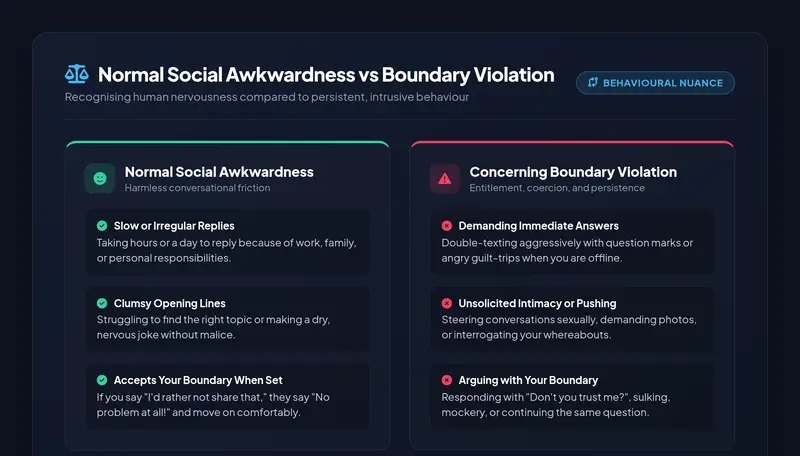
Recognizing concerning dynamics is not about psychoanalyzing a stranger; it is about recognizing specific behavioral patterns that compromise your comfort:
Behaviors That Require Immediate Boundaries or Disengagement
- Persistent Pressure After "No": Continuing to ask for phone numbers, private social media, or in-person meetings after you have clearly declined.
- Unsolicited Sexual Comments or Media: Introducing explicit sexual conversation, demanding intimate media, or sending unprompted explicit photos.
- Entitlement & Demands for Access: Expecting instant replies, getting angry if you take a few hours to message back, or interrogating who else you are talking to on the app.
- Attempting to Isolate or Rush: Urging you to keep your conversations secret, rushing you off the platform before rapport is built, or declaring intense love within days. For how this develops, see How Romance Scammers Build Trust.
- Hostile or Passive-Aggressive Outbursts: Mocking your caution ("You're paranoid"), guilt-tripping ("I guess you don't care"), or switching abruptly from charm to insult.
- Probing for Sensitive Logistics: Asking intrusive questions about your home address, daily commuting routes, exact salary, or financial assets.
You Don't Have to Keep Explaining Yourself
When someone pushes against a boundary, a common instinct is to over-explain: you offer apologies, explain your busy schedule, or craft elaborate justifications to soften the blow.
Unfortunately, offering elaborate explanations often gives an intrusive person room to negotiate. They view your reasons as hurdles to solve rather than a firm decision to respect.
A healthy boundary is short, clear, and neutral. It does not require a backstory, an apology, or permission:
Plain, Effective Boundary Scripts
- "I'm not comfortable with that."
- "I prefer to keep conversations on this app for now."
- "I'm not ready to meet in person yet."
- "I don't share private photos online."
- "I don't feel we are a good match, and I am going to end our conversation here. Wishing you the best."
Once you have stated a boundary once, you do not need to restate it three times. If they push back, argue, or dismiss your preference, you have your answer: they have shown an unwillingness to respect your autonomy.
What to Do When You Feel Uncomfortable
If a conversation or interaction begins to cause tension, anxiety, or unease, take these practical steps in sequence:
- Pause Before Responding: Step away from your phone. You are under no obligation to reply immediately, especially when feeling pressured or provoked. A 30-minute pause helps you regain emotional clarity.
- Stop the Back-and-Forth: If someone is insulting you, arguing with your boundary, or escalating, stop trying to reason with them. Disengage completely.
- Preserve Evidence If Appropriate: If messages involve harassment, financial solicitation, threats, or blackmail, take screenshots that clearly show their username, profile image, and the timestamped message text.
- Block the Person: Cut off their ability to reach you. Blocking is not an act of aggression; it is a basic personal hygiene tool for digital peace.
- Submit an In-App Report: On Amoura, tap the three dots in the conversation or profile view and select Block and Report. Select the matching category (e.g. Harassment, Inappropriate Content, or Spam / Fake) and provide context so our moderation team can inspect the account. For details on how reports are handled, see our guide on How to Report a User on Amoura.
- Talk to Someone You Trust: Mention the interaction to a trusted friend or family member. Sharing your experience breaks any feeling of isolation and grounds your perspective.
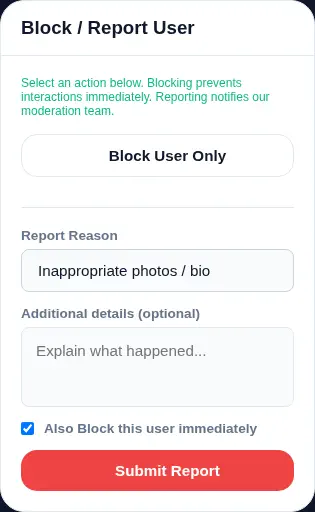
Amoura Block and Report modal — choosing the appropriate category immediately severs contact and submits logs for moderation review.
If Someone Keeps Contacting You
In some instances, someone who has been blocked on one channel may attempt to circumvent the boundary by creating new accounts, messaging through alternative social profiles, or calling from hidden numbers.
Persistent unwanted contact is harassment. Managing it requires strict, unwavering disengagement:
- Do Not Reply: Never send "Stop messaging me" or "Leave me alone" in response to repeated contact. Any reply—even a hostile one—signals to the individual that their persistence successfully elicits a reaction.
- Block Every New Attempt Silently: Without engaging, block each new profile, number, or account immediately upon arrival.
- Tighten Social Privacy Settings: Set personal social media profiles to private, restrict direct messages to existing followers, and review follower lists to remove unknown accounts.
- Maintain a Timestamped Record: Keep a secure log of dates, times, usernames, and screenshots of every contact attempt. If the behaviour persists, this documentation is essential for reporting stalking or harassment to the police.
If Someone Threatens, Intimidates, or Blackmails You
If someone threatens your physical safety, claims they will share private images, or attempts to extort money from you, the interaction has crossed from interpersonal awkwardness into criminal conduct.
In these high-stakes moments, keep these safety principles front and center:
Never Pay, Retaliate, or Negotiate
Blackmailers and extorters rely on panic. Paying money or conceding to demands never resolves extortion; it simply confirms that the threat works and leads to escalating demands. Stop communicating immediately.
- Preserve the Evidence: Capture full screenshots of threatening messages, user profiles, payment demands, and associated account handles.
- Image Blackmail Protocol: If someone is threatening to publish private photos, visit StopNCII.org to generate digital hashes that prevent uploads across major platforms, and read our dedicated guide on Why You Should Never Send Intimate Photographs.
- Contact the Authorities: In the UK, report non-urgent threats, stalking, or harassment to the police by calling 101. If you are in immediate physical danger, call 999 without hesitation.
Stop Trying to Resolve the Situation Yourself
Many well-intentioned people spend days trying to "fix" an uncomfortable situation. They attempt to educate a rude match on manners, debate an aggressive person into apologizing, or play amateur detective trying to track down a catfish's true identity.
Engaging in these debates almost always prolongs distress. You are not responsible for reforming, educating, or exposing bad actors on dating apps.
Your only responsibility is your own well-being. Once you recognize that someone's behavior is pressuring, uncomfortable, or suspicious, hand off the problem: block the individual, submit an in-app report to our moderation team (see How to Block and Report Someone on a Dating App and How Amoura Moderation Works), and move forward with members who treat you with genuine respect.
Frequently Asked Questions
What if I'm not sure whether the behaviour is serious enough to report?
You do not need absolute certainty. If someone's messages feel sexually inappropriate, threatening, pressuring, or fraudulent, report them. Our moderation team reviews the context and account history against our Community Guidelines. Submitting a good-faith report simply alerts moderators to look into the situation.
Do I need proof before blocking someone?
No. Blocking is an autonomous personal choice, not a legal verdict. You can block anyone at any moment for any reason, whether they were overtly rude or you simply realized there is no chemistry. You never need proof or justification to end contact.
Should I reply to someone who is making me uncomfortable to tell them why?
Only if you feel safe doing so and want to give a simple, one-line closing message (e.g. "I'm not comfortable with this conversation and am going to unmatch now."; see Online Dating Etiquette for closure scripts). However, if their behaviour is aggressive, abusive, or frightening, you do not owe them a closing message. Simply block and report immediately.
What if they keep trying to contact me from new accounts?
Do not engage or respond. Block each new account silently. Ensure your personal social media accounts are locked down to private, and keep timestamped screenshots of every contact attempt. If persistent contact continues, report the pattern to local police as harassment.
What should I do if I already gave them my phone number or address?
Block their number immediately on your mobile device and messaging apps. Adjust your WhatsApp privacy settings to hide your profile photo and status from non-contacts. If you shared a home address and they make threatening statements, inform a trusted friend immediately and report the threat to the police on 101 (or 999 if in immediate danger).