
There Is No Magic Number of Days
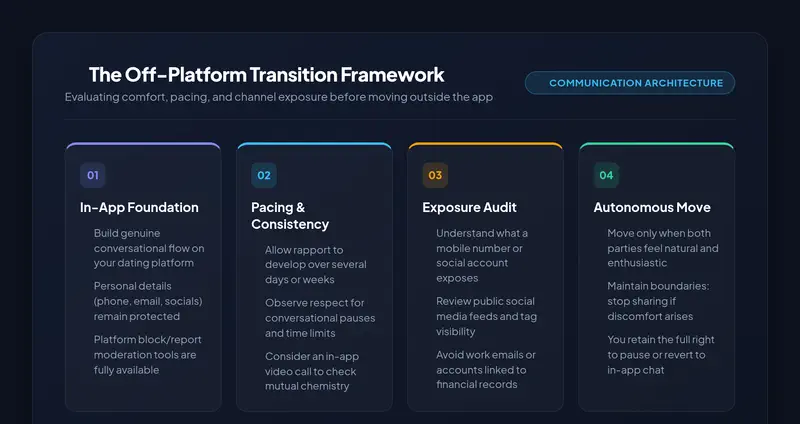
When chatting with someone new on a dating app, one of the most common crossroads is deciding when to move the conversation onto another platform—such as WhatsApp, direct text messaging, Telegram, or social media.
Dating culture often creates unspoken rules around timing. Some people suggest moving after three days; others insist on waiting several weeks or holding off until an in-person meeting has taken place. In truth, there is no universal calendar timetable for moving off a dating app. What feels comfortable and natural for one person may feel rushed or premature for someone else.
The decision to share personal contact details should be guided by consistency, trust, and personal comfort rather than an arbitrary count of days. A meaningful connection does not suffer because you prefer to chat in-app for another week, nor does exchanging numbers after a great initial conversation guarantee that everything will go smoothly. What matters is that both people share control over the pace.
Autonomy Over Timetables
You are never obligated to move off an app to prove your interest or sincerity. Anyone who genuinely values getting to know you will be happy to chat where you feel most secure.
Why People Move Off Dating Apps
Suggesting an external messaging service is a completely standard part of modern dating and is not inherently suspicious or malicious. People frequently suggest moving off-platform for practical, everyday reasons:
- Everyday Messaging Convenience: Most people check everyday messaging apps (like WhatsApp or iMessage) more frequently than dating apps. It is often simply easier to keep conversations in one central inbox alongside friends and family.
- Notification Management: Many users disable push notifications on dating apps for privacy reasons at work or around friends. Moving to a regular messaging app ensures timely replies and smoother scheduling.
- Richer Communication Features: Messaging apps frequently support seamless voice notes, quick video snippets, and media sharing that allow people to communicate more dynamically than basic text prompts.
- Signalling Genuine Interest: Offering a phone number or social handle can be a mutual signal that both individuals feel a spark and want to move past the casual browsing phase.
Understanding that moving off-platform is a normal desire helps prevent unnecessary paranoia. However, while the desire is natural, the timing, pressure, and context determine whether it is appropriate for you.
Reasons to Take Your Time
While exchanging numbers can be a positive milestone, there are distinct circumstances where slowing down and keeping the conversation inside the dating app is the sensible choice:
Situations That Call for Pausing
- Immediate Pressure: If someone asks for your personal number or WhatsApp within the first three messages before establishing any conversational rapport.
- "I Hate This App / I'm Deleting My Account": A classic rushing tactic where someone claims they are logging off immediately and insists you must give them your phone number right now or lose touch.
- Evasion of In-App Features: If the person refuses to use in-app messaging or avoids an in-app video chat, claiming they can "only talk on WhatsApp or Google Chat."
- Inconsistent Stories or Vague Details: If their background, career, or answers feel evasive or conflicting, keep communication within the app until consistency is proven.
- Premature Financial or Investment Talk: Anyone mentioning crypto, financial struggles, business investments, or wire transfers should never be given personal off-platform contact details.
Scammers frequently rush users off dating apps because dating platforms employ automated spam filters and account moderation teams. Once a conversation leaves the app, dating app moderation teams cannot see what is said or protect you from off-platform behavior. For deeper insights into manipulation tactics, read our guide on How Romance Scammers Build Trust.
What to Consider Before Sharing a Phone Number
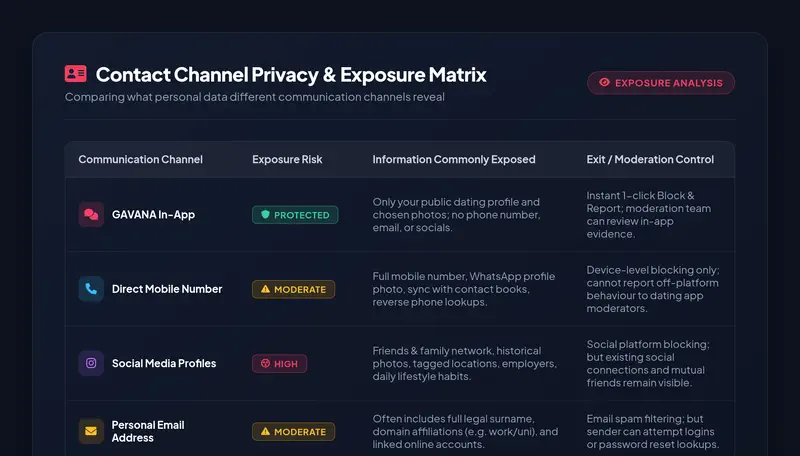
Because mobile numbers are exchanged so routinely in everyday life, many people treat giving out a phone number as a harmless, low-stakes step. However, in modern digital environments, a phone number is an essential piece of personal identifying data.
Before handing over your mobile number, keep in mind what that number may unlock:
- WhatsApp & Messaging Profile Exposure: Saving your number into their address book can automatically expose your WhatsApp profile photograph, "About" status, and "Last Seen" timestamps depending on your privacy settings.
- Reverse Lookup and Caller ID Tools: Many third-party directory apps and search services index mobile numbers alongside full legal names and social profiles.
- Account Recovery Connections: Mobile numbers are commonly used for two-factor authentication or account lookups across online platforms.
Quick Privacy Check Before Sharing
Before giving someone your number, open WhatsApp or your primary messaging app and check your Settings > Privacy. Set your profile photo, status, and last seen to "My Contacts" rather than "Everyone." This ensures a stranger cannot immediately view your private details simply by typing your number into their phone.
Moving to Email or Other Messaging Services
Occasionally, matches suggest moving conversation to email or specialized platforms like Telegram, Google Chat, or Discord. While email might seem quaint or formal, it requires thoughtful caution:
-
Email Address Identifiers: Personal email addresses frequently contain your full legal first name, middle initial, and surname (e.g.
first.last@gmail.com). Work or institutional emails (e.g.@company.co.ukor@ac.uk) reveal your exact employer or academic institution and should never be used for dating conversations. - Malicious Links and Attachments: Email and messaging apps allow recipients to send attachments, PDFs, and shortened web links with fewer security filters than dating platforms. Never click unexpected links, download zip files, or open shared spreadsheets from someone you are getting to know.
- Alternative Messaging Apps: Apps like Telegram allow usernames without sharing phone numbers, which can be useful for privacy. However, ensure your settings hide your phone number from non-contacts.
You Can Always Change Your Mind
One of the most important principles of modern dating is that **consent and comfort are continuous**. You do not owe someone your phone number, social handles, or personal contact details simply because you have had an enjoyable conversation for an hour, a day, or a week.
If someone asks to move to WhatsApp and you are not ready, you do not need to make up an elaborate excuse or apologize. A polite, clear, and direct reply is all that is required:
Practical Scripts for Declining or Pausing
- Simple & Direct: "I'm enjoying our chat, but I prefer to keep my conversations on here until we've gotten to know each other a bit better!"
- Pre-Date Boundary: "I usually wait until we meet up in person before swapping numbers, but I'm looking forward to talking more on here."
- Focus on Chemistry: "Let's stick to chatting here for now—it's just how I like to do things while we see if we click."
Pay close attention to how they respond to your boundary. A considerate person will reply along the lines of: "Totally understand, no problem at all!" and continue chatting normally.
If, however, they respond with irritation, passive aggression ("What, don't you trust me?"), or mock your caution, they have provided valuable information. Their inability to respect a minor boundary early on shows that they will struggle to respect larger boundaries later. For more on these warning patterns, review Online Dating Red Flags You Shouldn't Ignore.
When Moving Off-Platform Becomes a Warning Sign
While moving to personal messaging is normal, scammers, fraudsters, and bad actors specifically weaponise this transition. Recognizing the difference between a natural request and a manipulative tactic is key:
- Evading Platform Bans: Fraudsters know their profiles may be flagged and deleted by automated moderation. They race to move victims to WhatsApp or Telegram before their dating profile gets suspended, ensuring they maintain contact even after being banned.
- Avoiding Chat Evidence: Dating app moderation teams can inspect in-app chat logs when a user reports abuse. Once you move to encrypted third-party apps, dating platforms have no visibility into abusive messages, extortion attempts, or financial solicitations.
- Moving to Scripted Scams: Romance fraud syndicates often use junior operators on dating apps whose sole job is harvesting phone numbers. Once collected, they hand the target off to senior operators on WhatsApp to execute crypto or emergency fund scams. See How to Recognise a Romance Scam for full details.
If a match moves you to WhatsApp and immediately begins discussing crypto investments, tragic family emergencies, or requesting money, stop communicating immediately and refer to our guide on What to Do If Someone Asks You for Money.
A Sensible Approach: The Practical Checklist
When considering whether to take a conversation outside a dating app, use this quick practical checklist to ground your decision:
The Off-Platform Readiness Checklist
- Take your time: Move only when you feel natural rapport, not to satisfy someone else's rush.
- Share only what you choose: You control which channels you make available.
- Audit channel exposure: Verify what your WhatsApp profile, status, or social media feed reveals before sharing.
- Keep conversational boundaries: Deflect invasive questions about financial status, addresses, or work schedules.
- Watch for pressure: Notice how they react when you ask to stay in-app; irritation is a major signal.
- Never share credentials: Never disclose verification codes, passwords, or login links under any pretext.
- Plan in-person safety: When you eventually decide to meet, follow our verified Safe First Date Guide and comprehensive advice on moving from online conversation to a real relationship.
Frequently Asked Questions
Is it a red flag if someone asks for my phone number on the first day?
It depends on the context. Asking for a number early is common for people who dislike using dating apps or check them infrequently. However, if they insist on it aggressively, refuse to chat on the app, or react defensively when you politely ask to stay in-app, that resistance to boundaries is a clear warning sign.
What should I do if a match says they are deleting the app and need my number right now?
Do not feel rushed. This is a common pressure tactic used to bypass your natural caution. You can say: "No problem if you need to take a break from the app! I'm not ready to swap numbers just yet, but wish you all the best." A genuine connection will not evaporate simply because you held a healthy personal boundary.
Can I use in-app video calling instead of giving out my phone number?
Yes. On Amoura, you can initiate a live video call directly within your conversation window. This allows you to check vocal chemistry and real-time appearance without having to disclose your personal mobile number, email, or social media handles.
Is it better to share a social media profile or a phone number?
It depends on which profile holds less sensitive information. If your social media account is public and contains tagged photos with friends, family members, and workplaces, a phone number with strict WhatsApp privacy settings may expose less data. Conversely, a private, curated social account without location tags may feel more comfortable for some. Always audit what is publicly visible first.
Can I still report someone on Amoura if we already moved to WhatsApp?
Yes. If you connected on Amoura and they subsequently harassed, scammed, or threatened you on another messaging app, you can still return to their profile or match thread on Amoura to block and submit a report. Provide details of what occurred so our moderation team can review their account history and take appropriate action.