
What Is Catfishing?
Catfishing refers to the practice of creating a fabricated or substantially misleading identity online to pursue a relationship with another person.
The term originated in popular culture and has since become standard vocabulary for online dating deception. A person who catfishes typically borrows photographs belonging to someone else—often a model, an influencer, or an acquaintance—and invents a completely fictional biographical backstory, career, and personal history.
It is essential to distinguish catfishing from ordinary, healthy privacy decisions. Using a first name, a personal nickname, choosing not to publish your exact workplace on a public profile, or keeping your social media handles private are sensible personal boundaries. Catfishing, by contrast, involves an active, sustained deception about who you fundamentally are, designed to lure someone into an emotional connection under false pretences.
Editorial Scope Note
While catfishing overlaps with fake profiles and fraud, it has distinct emotional dynamics. For a broader look at identifying synthetic accounts or bot profiles, explore our guide on How to Spot a Fake Dating Profile. For situations involving monetary demands or crypto schemes, read How to Recognise a Romance Scam.
Why Do People Catfish? Understanding Motives
Because the harm of catfishing feels so intensely personal, victims often wonder why someone would invest weeks or months sustaining an elaborate fiction. Popular media often portrays catfishing as purely malicious, but in reality, motivations are multifaceted:
1. Insecurity and Low Self-Esteem
Many individuals who catfish feel deeply insecure about their physical appearance, social standing, age, or lifestyle. They convince themselves that nobody would accept them as they are, leading them to adopt an idealized persona to experience romantic validation.
2. Loneliness and Escapism
For some, an online persona functions as emotional escapism from an unhappy or isolated real-world life. Living through an adventurous, confident character provides a temporary sense of excitement, connection, and emotional intimacy that feels absent offline.
3. Curiosity and Exploring Identity
Some individuals use fictional profiles to explore facets of their identity—such as gender expression, sexual orientation, or personality traits—that they do not feel safe or ready to express openly in their physical communities.
4. Thrill-Seeking, Revenge, or Malice
In darker instances, people catfish out of boredom, malice, or a desire for control. They may seek to humiliate an ex-partner, spy on an acquaintance, or derive amusement from manipulating someone's genuine feelings.
Understanding these motivations is not about excusing the behavior—the emotional harm caused by catfishing is very real. Rather, recognizing these motives helps demystify the deception and dispels the mistaken belief that the victim was somehow foolish for trusting someone.
How Catfishing Develops and Unravels
Catfishing rarely begins with a grand, sinister master plan. In many cases, it starts impulsively: someone creates a profile with borrowed photos just to browse or chat casually. But as a mutual spark ignites, the fiction becomes increasingly difficult to dismantle.
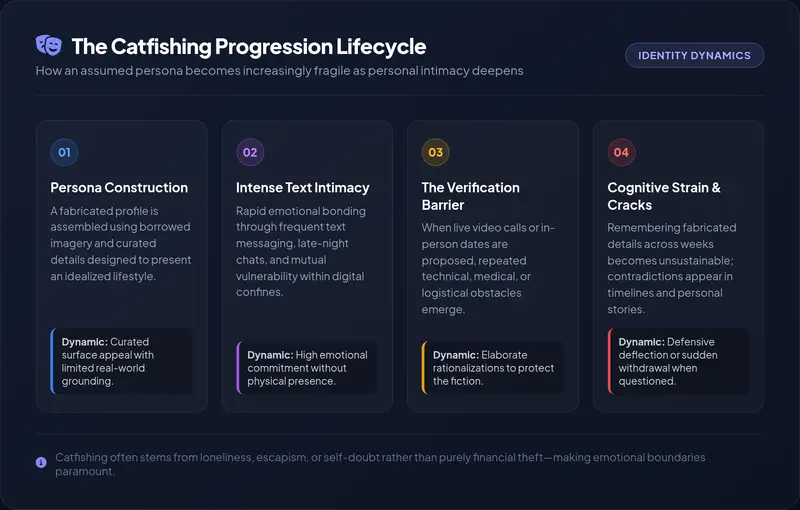
Figure 1: The 4-stage lifecycle of catfishing, showing how initial digital intimacy inevitably encounters the verification barrier.
The dynamic typically progresses through distinct phases:
- Persona Construction: The person sets up a profile using attractive photos and a compelling biographical story. The character is carefully crafted to be appealing, attentive, and emotionally available.
- Accelerated Digital Intimacy: Communication is intense. Without the vulnerabilities of physical presence, conversations quickly move into deep secrets, late-night phone calls, and passionate declarations. Both parties feel an extraordinary bond.
- The Inevitable Verification Barrier: Eventually, the relationship reaches a natural milestone: an invitation to meet for coffee, attend an event, or have a brief video call. Because revealing their real appearance would shatter the fantasy, the person invents elaborate, dramatic reasons to cancel.
- Cognitive Strain and Inconsistencies: Maintaining hundreds of fictional details across weeks or months requires immense mental effort. Timelines begin to slip, details contradict earlier statements, and the person becomes defensive or withdraws when questioned.
Signs Someone May Not Be Who They Say They Are
No single signal conclusively proves that someone is catfishing. Genuine people occasionally face broken phone cameras, busy travel schedules, or personal shyness. However, when multiple warning signs cluster together over time, you should pause and evaluate the connection carefully.
1. Persistent Excuses to Avoid Live Video Communication
Every suggestion of a video call is met with an obstacle: their camera is broken, the connection is too weak, they are in a noisy transit terminal, or family emergencies intervene. While a temporary cancellation is normal, an absolute refusal over weeks is a primary indicator.
2. Repeated Dramatic Cancellations of In-Person Plans
They agree enthusiastically to meet in person, but at the last minute—often just hours before the planned meeting—a dramatic crisis arises: a sudden car breakdown, an unexpected hospital admission, or an urgent work trip abroad.
3. Slipping Biographical Details and Inconsistencies
Stories about their family, hometown, educational background, or daily routine change subtly between conversations. They may forget key events they previously described or confuse details they claimed to share with you.
4. Ghost-Like or Isolated Digital Footprint
In an era where most adults maintain some modest digital trail, they seem to exist in total isolation. They claim to have no friends who use social media, have zero tagged photos anywhere, or their public presence consists entirely of a brand-new profile with no genuine interaction.
5. Defensive Deflection and Guilt-Tripping
When you gently express that you would feel more comfortable with a quick video hello or a casual coffee, they react defensively: "Don't you trust me?" or "If you loved me, you wouldn't interrogate me like this." (for deeper analysis of manipulation tactics, read Online Dating Red Flags You Shouldn't Ignore).
Photos and Identity: A Balanced Perspective
Photographs are often the central piece of evidence people focus on when suspecting catfishing. However, visual cues require thoughtful interpretation:
Why Photographs Can Be Misleading
Today's digital environment makes borrowing or manipulating photos remarkably easy. Someone can assemble an impressive set of pictures from an overseas social media creator with a low profile, or use subtle generative filters to alter their appearance.
Conversely, legitimate members often present photos that could be misinterpreted:
- Someone may use professional portraits or modeling shots simply because they work in fashion, acting, or fitness.
- Someone may have only a few photos because they rarely take pictures of themselves.
- Someone may use older photos from a year ago because they haven't taken recent portraits.
Sensible Observation, Not Vigilante Investigation
You do not need to spend hours conducting forensic image analysis, tracking down metadata, or hunting through public archives. Healthy online dating should not feel like an undercover investigation. If someone's visual consistency feels doubtful, the most respectful and conclusive step is simply suggesting a 2-minute live video call or a casual meeting in a public café.
How to Reduce the Risk of Being Deceived
Protecting yourself from catfishing does not require becoming cynical or suspicious of everyone you meet. It simply requires adopting grounded, healthy relationship habits:
Pace the Relationship Mindfully
Keep emotional investment aligned with verifiable reality. It is enjoyable to chat frequently, but remind yourself that until you have interacted in real time, you are communicating with an unconfirmed digital representation.
Suggest an In-App Video Chat Early
Within a week or two of consistent messaging, suggest a quick, informal video hello. Amoura provides an integrated Video Call button () directly inside the chat header. Frame it casually: "I'd love to say a quick hello on video to put a face and voice to our chats!"
Plan Low-Stakes In-Person Meetings
Transition from digital chatting to a simple 30-minute coffee or walk in a busy public location reasonably early. A person who is genuine and locally based will welcome the opportunity to meet (see our checklist on How to Have a Safe First Date).
Guard Confidential and Financial Details
Never disclose your home address, exact daily commute, banking information, or private intimate media to someone whose identity remains unconfirmed (see Protecting Your Personal Information While Dating Online).
A Video Call Does Not Prove Full Identity
Seeing someone on video confirms that a living person is on the other end and matches their general appearance. However, it does not verify their legal name, character, marital status, or intentions. Live video is a valuable sanity check, but not an infallible guarantee of honesty. For more on the boundaries of verification, see Profile Verification & Authenticity.
Catfishing vs. Romance Scams: What Is the Difference?
While the terms are often used interchangeably in media headlines, catfishing and romance scams represent distinct phenomena that require different responses.
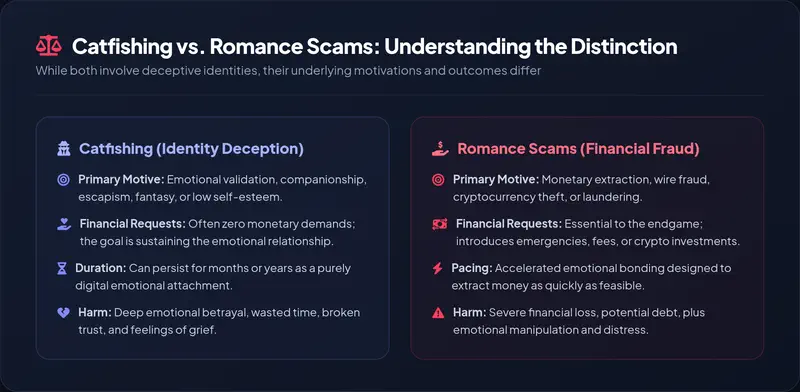
Figure 2: Comparing identity deception driven by emotional validation against organized financial fraud.
The essential distinctions include:
- The Financial Component: In a romance scam, extracting money, cryptocurrency, or gift cards is the primary objective. In classic catfishing, money is rarely requested; the deception is driven by psychological, emotional, or social desires.
- The Nature of the Harm: Romance scams result in tangible financial devastation and potential legal complications. Catfishing results in profound emotional betrayal, lost time, and psychological heartbreak.
For a comprehensive breakdown of financial manipulation, emergency loan tactics, and crypto schemes, see our dedicated guide on How to Recognise a Romance Scam.
What To Do If You Suspect You Are Being Catfished
If you come to realize that someone you have been communicating with is not who they claim to be, your immediate priority should be protecting your emotional well-being and privacy:
1. Do Not Confront Aggressively
Demanding an admission or sending angry accusations rarely brings closure. People who catfish often react by doubling down on complex lies, becoming intensely defensive, or abruptly vanishing. Simply disengage calmly.
2. Stop Sharing Information Immediately
Cease all communication. Do not share any further photos, personal updates, or thoughts about your day. Block their number on external messaging apps if you previously moved off-platform (for guidance, see When Is It Safe to Move a Conversation Off a Dating App?).
3. Report the Profile on Amoura
Use Amoura's Block / Report modal from the candidate card or chat options menu. Choose Spam or Fake Profile, note that the user appears to be impersonating someone else or operating under a false persona, and ensure Also Block this user immediately is enabled.
For detailed instructions on submitting reports, review: How to Report a User on Amoura and How to Block and Report Someone on a Dating App.
4. Be Kind to Yourself
Discovering you have been deceived can trigger embarrassment, anger, and self-doubt. Remember: extending trust, empathy, and genuine affection is an admirable human quality. The deceit reflects the other person's shortcomings, not your intelligence. Give yourself time to process the experience.
Frequently Asked Questions
Can someone catfish you even if they don't ask for money?
Yes, frequently. Many catfishing situations involve no financial requests whatsoever. The individual's goal is often emotional validation, escapism, fantasy companionship, or curiosity about how people perceive a different identity.
Does refusing a video call prove someone is catfishing?
Not definitively on its own. Someone might feel shy on camera, be having a bad day, or have genuine technical difficulties. However, if someone repeatedly refuses or cancels video calls over an extended period while professing strong romantic feelings, it is a significant signal that warrants caution.
Does an in-app video call prove someone's identity completely?
No. A video call confirms that the person's real-time appearance matches their profile photos and eliminates borrowed still imagery. However, it does not confirm their legal identity, character, relationship status, or truthfulness about their personal background.
Is it catfishing to use older photos or subtle photo filters?
Using older photos or minor filters is a common form of mild misrepresentation (often called "kittenfishing"), but it differs from full catfishing. Full catfishing involves fabricating a completely different identity, using someone else's imagery, and inventing an entirely false life story.
Should I hire a private investigator or try to find their real identity?
In virtually all situations, no. Trying to unmask, dox, or track down someone who deceived you consumes emotional energy and risks legal complications. The healthiest and safest course of action is simply to sever contact, report the profile on the platform, and move on.
How does Amoura help protect members from fictitious profiles?
Amoura implements several structural baselines: mandatory 18+ chronological age validation, one-time 6-digit email confirmation, an authoritative 2-photo minimum, and integrated in-app video calling. While no platform can guarantee human truthfulness, these systems remove anonymous placeholders and provide direct tools for members to verify connection pacing safely.